
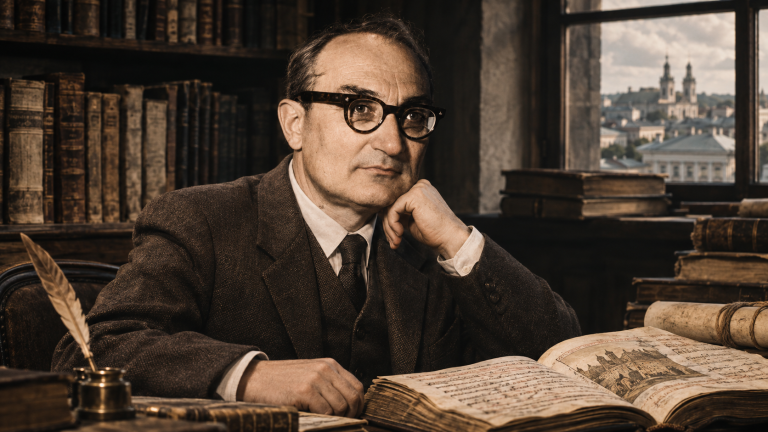
Chapter 1. A Childhood Shaped by the History of Belarus
Mikalaj Mikałajevič Ulaščyk was born on 14 February 1906 in the village of Vićkaŭščyna, near Minsk, in what is now the Dziaržynsk district of Belarus. He grew up in a peasant family in which books and reading were valued. His childhood coincided with a period of profound political change, as the Russian Empire, the First World War, and the revolutions transformed the region.
Ulaščyk later recalled that his interest in Belarusian history and ethnography developed during his school years. In 1919, his school became a Belarusian-language institution, an experience that helped awaken his curiosity about the history and culture of his homeland.
He completed his secondary education in 1924 and entered the Belarusian State University in Minsk, studying at the social and historical department of its pedagogical faculty. He attended lectures and seminars led by prominent historians, including Uładzimier Pičeta and Mitrafan Dounar-Zapolski.
While studying, Ulaščyk also worked at the Belarusian State Library. He began publishing in 1924 and took part in student historical and local-history activities. He travelled through Belarus, visiting villages and gathering material that would later inform his research.
His early interests included archaeology, ethnography, and the history of the Belarusian countryside. He was not content to study the past only through official documents: he wanted to understand the country through its landscapes, communities, traditions, and surviving records.
Chapter 2. A Historian Targeted by the Soviet State
Ulaščyk graduated from the university in 1929. His involvement in Belarusian national and cultural life, however, unfolded during a period when the Soviet authorities were increasingly suspicious of intellectuals associated with national movements.
On 16 June 1930, he was arrested by the Soviet political police. The authorities accused him of involvement in the alleged Union for the Liberation of Belarus, a supposed anti-Soviet organisation used in the repression of Belarusian intellectuals. The case was fabricated, and the accusations formed part of a wider campaign against the Belarusian cultural and academic community.
On 10 April 1931, Ulaščyk was sentenced to five years of exile and sent to Nolinsk in the Vyatka region. His punishment separated him from his homeland and interrupted his developing academic career.
In July 1932, he was arrested again. In June 1933, he received a further sentence and was transferred to a labour camp in the Mariinsk area of Siberia, later living in the settlement of Suslovo in the Kemerovo region.
He was released in the spring of 1935, but without permission to return to Belarus. He was forced to build a life in different parts of the Soviet Union, working as a teacher of history and geography.
The arrests did not establish any genuine crime. They reflected the Soviet state’s persecution of people whose cultural, intellectual, or political independence was considered dangerous.
Chapter 3. Scholarship in Exile and a Third Arrest
Despite the restrictions imposed on him, Ulaščyk continued to study history. He worked in educational institutions in different Soviet regions and eventually moved to Leningrad in 1939.
His academic ambitions remained alive. He prepared for postgraduate research and continued to develop his knowledge of Belarusian history, agriculture, and historical sources.
On 23 June 1941, shortly after Nazi Germany invaded the Soviet Union, Ulaščyk was arrested for the third time. He was sent to Zlatoust in the Chelyabinsk region.
His release came through the intervention of the distinguished Soviet physiologist Leon Orbeli. On 28 November 1942, Ulaščyk was freed and was able to return to scholarly work.
In 1944, he entered postgraduate study at the Institute of History of the Academy of Sciences of the USSR in Moscow. He defended his Candidate of Sciences dissertation in 1947.
For a short period, he was able to teach at Moscow State University. Yet the opportunity did not last. In 1949, he lost his position, and the political pressure surrounding his career continued.
His experience illustrates the precarious position of scholars whose research and personal histories did not fit comfortably within the ideological expectations of the Soviet system.
Chapter 4. A Fourth Arrest and the Return to Research
On 23 December 1950, Ulaščyk was arrested for the fourth time. He was sent to a labour camp in the settlement of Suslovo in Siberia.
This arrest again interrupted his academic work and separated him from the intellectual environment he had struggled to establish. He remained imprisoned until 25 March 1955.
After his release, he returned to Moscow. Although he could not resume the life he might have built in Belarus, he continued his research at the Institute of History of the Academy of Sciences of the USSR, where he worked until the end of his life.
In 1964, he defended his doctoral dissertation and received the degree of Doctor of Historical Sciences.
Ulaščyk became a leading specialist in the history of the Grand Duchy of Lithuania, the history of Belarusian and Lithuanian peasantry, source studies, and historical writing. His work on medieval chronicles and the publication of Belarusian-Lithuanian historical texts made important sources accessible to scholars.
He was particularly interested in the relationship between historical evidence and the interpretation of the past. His scholarship challenged simplified accounts of the history of the Grand Duchy of Lithuania and the peoples who had lived within it.
His research was not merely an academic occupation. It was a long effort to preserve historical complexity against ideological distortion.
Chapter 5. The Historian and the Memory of His Homeland
Ulaščyk spent most of his mature professional life in Moscow, but Belarus remained at the centre of his historical interests.
He wrote extensively about the history of Belarus, the Grand Duchy of Lithuania, rural society, and the development of historical sources. His publications and editorial work contributed to the foundations of modern Belarusian historiography.
He also left an important body of autobiographical and epistolary material. His letters and recollections offer insight into the life of a scholar whose work was repeatedly interrupted by arrest, exile, and political restrictions.
One of his distinctive contributions was his attention to oral testimony and local memory. He understood that the history of a country could not be reconstructed from official documents alone. Family recollections, village stories, and the experiences of ordinary people could also preserve evidence that formal institutions had overlooked or neglected.
Ulaščyk died in Moscow on 14 November 1986. In accordance with his connection to his homeland, he was buried in Minsk at Chyzhouski Cemetery.
His life had been shaped by four arrests, years of exile and imprisonment, and the persistent difficulty of working outside the country whose history he studied. Yet he continued to research, document, and interpret Belarusian history.
Mikalaj Ulaščyk’s legacy is that of a historian who refused to allow political repression to erase the complexity of his nation’s past. Through chronicles, archival research, scholarship, and personal testimony, he helped preserve a historical memory that outlasted the system that had tried to silence him.
Historical Note
Mikalaj Mikałajevič Ulaščyk (14 February 1906 – 14 November 1986) was a Belarusian historian, archaeographer, ethnographer, and scholar of the history of the Grand Duchy of Lithuania. Born in Vićkaŭščyna near Minsk, he graduated from the Belarusian State University in 1929 and became an important researcher of Belarusian history and historical sources.
He was arrested four times by Soviet authorities: in 1930, 1932, 1941, and 1950. He experienced exile and imprisonment in different parts of the Soviet Union and was finally released in March 1955. He later worked at the Institute of History of the Academy of Sciences of the USSR in Moscow and received his doctorate in historical sciences in 1964.
This biography is based on published biographical research, Ulaščyk’s own autobiographical correspondence, and historical reference sources. His arrests and sentences are presented as acts of Soviet political repression, not as evidence of genuine criminal activity.