
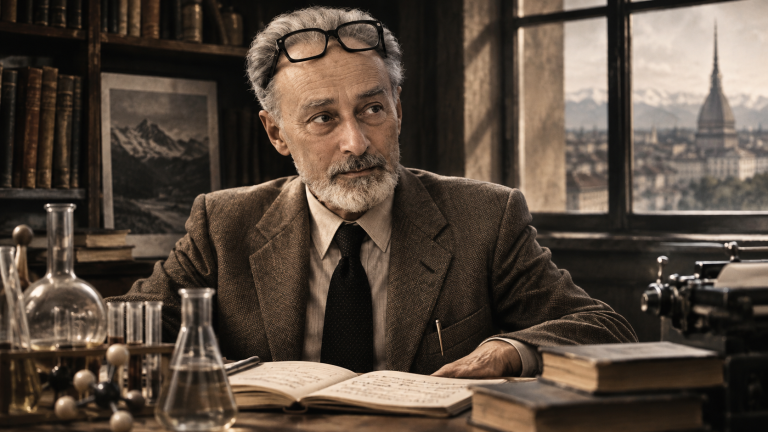
Chapter 1. A Childhood in Turin and a Passion for Science
Primo Levi was born on 31 July 1919 in Turin, Italy, into a Jewish family with deep roots in the Piedmont region. His family lived in the same Turin apartment building where he would spend most of his life.
From an early age, Levi was drawn to books, scientific questions, and the natural world. He attended the Massimo d’Azeglio classical secondary school in Turin, where he developed an interest in chemistry and physics. In 1937, he enrolled in the University of Turin to study chemistry.
His university years coincided with the growing influence of Fascism and the introduction of antisemitic legislation in Italy. In 1938, the Fascist government enacted racial laws that restricted the rights of Jewish Italians, including access to education. Levi was nevertheless able to continue his studies, although the political climate increasingly affected his academic life.
In 1941, he graduated with a degree in chemistry. His diploma carried a reference to his Jewish background, reflecting the discriminatory restrictions of the period.
Levi entered professional life as a chemist, initially working in a mining-related laboratory and later in Milan for the Swiss pharmaceutical company Wander. He believed in the practical value of science: observing carefully, testing assumptions, and understanding how the material world worked.
Chapter 2. Resistance, Arrest, and Deportation
After the fall of Mussolini’s first government in July 1943 and the armistice between Italy and the Allies in September, German forces occupied much of northern and central Italy. Fascist authorities continued to operate in the German-controlled territory.
Levi joined an anti-Fascist resistance group in the mountains of the Aosta Valley. His experience as a partisan was brief and difficult. On 13 December 1943, he was arrested near Brusson by Fascist forces together with several companions.
During interrogation, Levi decided to identify himself as Jewish rather than risk being treated as a partisan fighter. He was consequently sent to the Fossoli internment camp near Modena, which was under Italian Fascist control before the Germans took it over.
In February 1944, German authorities organised the deportation of prisoners from Fossoli to Auschwitz. Levi was transported with hundreds of other Italian Jews in a freight train. The journey lasted several days.
Upon arrival, he was selected for forced labour rather than immediate murder. He was registered as prisoner number 174517 and sent to Auschwitz III-Monowitz, a camp connected to the industrial complex of the German chemical company IG Farben.
The world he encountered was organised around hunger, exhaustion, violence, humiliation, and the systematic destruction of human dignity.
Chapter 3. Auschwitz and the Struggle to Survive
At Monowitz, Levi was forced to work under brutal conditions. His scientific education eventually became important to his survival.
In 1944, after demonstrating his qualifications as a chemist, he was accepted as an assistant in the laboratory of the Buna synthetic-rubber factory, which was part of the IG Farben industrial complex. The laboratory position offered some protection from the worst physical demands of outdoor forced labour, although it did not free him from the camp’s violence or deprivation.
Levi later described the camp as a system designed not only to exploit and destroy human beings physically, but also to attack their identities, relationships, and sense of moral responsibility.
He observed the behaviour of prisoners, the mechanisms of survival, the different forms of solidarity, and the ways in which extreme circumstances transformed human relationships.
In January 1945, as the Soviet army approached, the SS evacuated most of the surviving prisoners from Monowitz on forced marches. Levi was ill with scarlet fever and remained in the camp infirmary. This circumstance spared him from the evacuation.
On 27 January 1945, Soviet troops entered Auschwitz and liberated the remaining prisoners.
Levi had survived, but liberation did not immediately restore his life. He spent months in a Soviet transit camp and began a long, complicated journey across Eastern and Central Europe. He finally returned to Turin in October 1945.
Chapter 4. Turning Memory into Literature
After returning to Italy, Levi resumed working as a chemist. He found employment in the chemical and paint industry, eventually becoming a manager at a small factory near Turin.
At the same time, he began writing about Auschwitz. His first major book, If This Is a Man (Se questo è un uomo), was published in 1947. It described his imprisonment and examined the mechanisms through which the concentration camp system attacked human dignity.
The book initially received limited attention, but it gradually became recognised as one of the most important literary testimonies of the Holocaust.
Levi did not write only to recount suffering. He sought to understand how the camp had functioned, how people behaved under extreme pressure, and what could be learned from the experience without simplifying or distorting it.
In 1963, he published The Truce (La tregua), describing the extraordinary and difficult journey home after liberation.
His later works expanded beyond direct autobiography. The Periodic Table (1975) connected chemistry, memory, family history, and human experience through stories inspired by chemical elements. The book demonstrated how deeply his scientific education shaped his literary imagination.
Levi continued to work as a chemist for many years while writing novels, essays, poetry, and short stories. His ability to combine scientific precision with moral reflection became one of the defining features of his work.
Chapter 5. A Voice Against Forgetting
In the decades after the war, Primo Levi became an internationally recognised writer and witness to the Holocaust. He travelled, gave interviews, met young readers, and spoke about the concentration camp system and the responsibilities of memory.
He was particularly concerned that future generations should understand how persecution develops: through discrimination, propaganda, the destruction of rights, the normalisation of cruelty, and the gradual exclusion of people from society.
In his writing, Levi resisted easy explanations. He examined the moral complexities of survival and warned against reducing historical experience to simple categories of heroes and villains.
His final major work, The Drowned and the Saved (1986), returned to the questions that had occupied him throughout his life: memory, responsibility, shame, violence, and the difficulty of understanding what happened in the camps.
Primo Levi died in Turin on 11 April 1987. He was found at the bottom of the stairwell in the building where he had lived. His death was widely reported as suicide, although questions about the circumstances have also been raised. The precise circumstances should therefore be treated with care.
His books remain central to Holocaust education and modern literature. They continue to challenge readers to examine the fragility of human dignity and the responsibility to preserve truthful testimony.
Levi’s legacy is not only that he survived Auschwitz. It is that he devoted much of the rest of his life to explaining what he had witnessed, asking difficult questions, and warning the world against forgetting.
Historical Note
Primo Levi (31 July 1919 – 11 April 1987) was an Italian Jewish chemist, writer, and Holocaust survivor from Turin. After joining an anti-Fascist resistance group in 1943, he was arrested by Fascist forces, interned at Fossoli, and deported by the Germans to Auschwitz in February 1944. He survived imprisonment at Auschwitz III-Monowitz and was liberated by Soviet forces on 27 January 1945.
After returning to Italy, Levi resumed his work as a chemist and became an internationally recognised author. His books, including If This Is a Man, The Truce, The Periodic Table, and The Drowned and the Saved, remain essential works of Holocaust testimony and literature.
This biography is based on documented historical sources. It distinguishes Levi’s own testimony and established historical events from later interpretations of his life and death.