
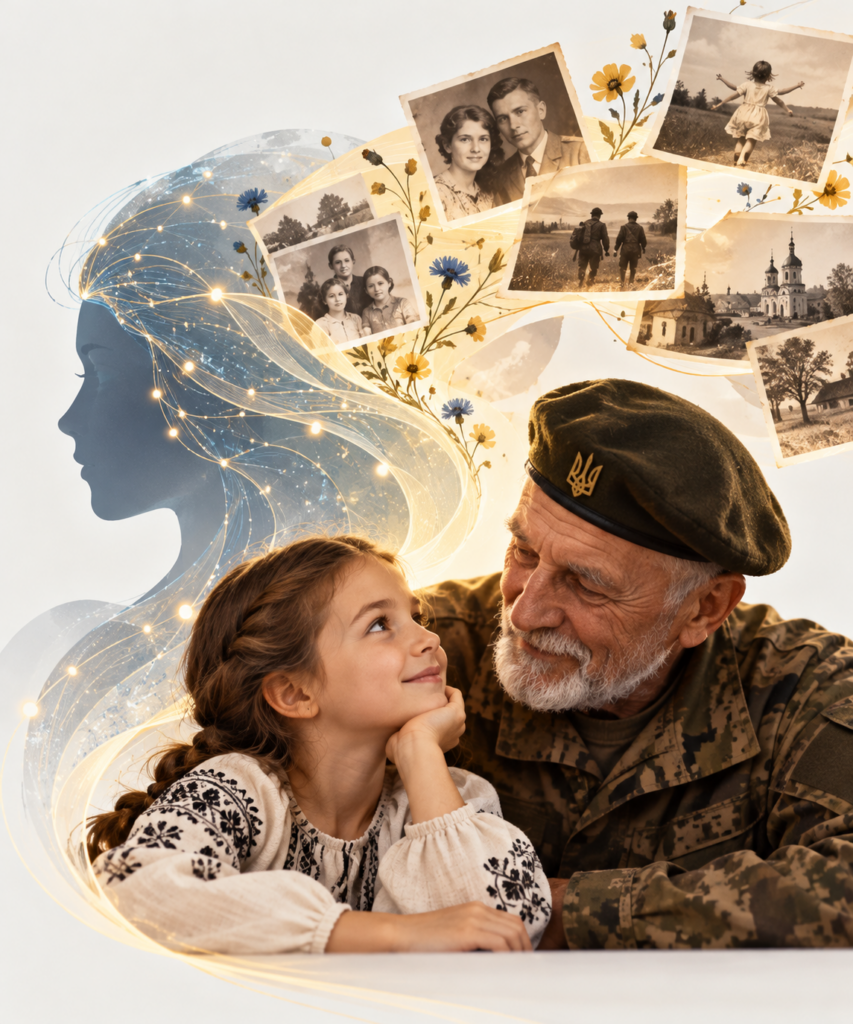
Format: 5 modules × 4 hours
Approach: Interactive learning, hands-on practice, and real-life stories
Target audience: Volunteers, psychologists, cultural activists, military families, and local history researchers
Module 1. Collecting and Preserving Oral Histories
- Learn to record and transcribe interviews with veterans and civilians.
- Learn to identify key emotional moments and significant events in personal narratives.
- Master interview techniques tailored to different age groups.
- Create a digital archive of three oral histories with annotations.
Practical assignment: Record a veteran’s or civilian’s story, use AI for transcription, and identify key events in the narrative.
Module 2. Digitizing and Restoring Memories
- Learn to restore old photographs using AI.
- Create interactive photo books and digital albums.
- Learn to animate portraits and colorize black-and-white photographs.
- Create a digital memorial album featuring restored photographs.
Practical assignment: Restore a family archive using AI-generated descriptions and organize the photographs chronologically.
Module 3. Reconnecting Families Through AI
- Learn to create supportive animated videos inspired by real memories, dreams, or childhood places.
- Learn to use AI for voice synthesis, memory colorization, and adding warm visual effects.
- Master AI-generated songs and poems that can be transformed into videos or audio messages for loved ones serving on the front lines.
- Create emotionally resonant memes featuring photographs, quotes, and symbols that help sustain morale.
- Create a collection of multimedia messages — an animation, a song, and a meme — for a specific family or service member.
Practical assignment: Create three supportive materials for a specific personal story: an animated video, a song or poem, and a visual meme, each featuring a personalized message.
Module 4. Creating Memorial Projects
- Learn to create interactive memorial webpages.
- Learn to develop virtual tours of places of remembrance.
- Create an interactive memorial featuring photographs, videos, and personal recollections.
Practical assignment: Build a memorial webpage using AI to organize content and incorporate interactive elements.
Module 5. Ethics, Safety, and Knowledge Sharing
- Understand the principles of confidentiality when working with personal data.
- Learn to recognize deepfakes and avoid distorting personal and collective memories.
- Create educational materials for other volunteers.
- Create an ethical code for the use of AI in memorial projects.
Practical assignment: Develop guidelines for ethical AI use and deliver a training session for another volunteer team.
Tools
Transcription and analysis: Claude AI, ChatGPT, Otter.ai, DeepSeek
Photo restoration: MyHeritage AI, Canva, DALL·E, Photomyne
Video and animation: Synthesia, Steve AI, D-ID, Pictory
Data organization: Microsoft Copilot, Notion AI, Google Workspace
Maps and locations: Google Earth, Mapillary, TimeMachine