
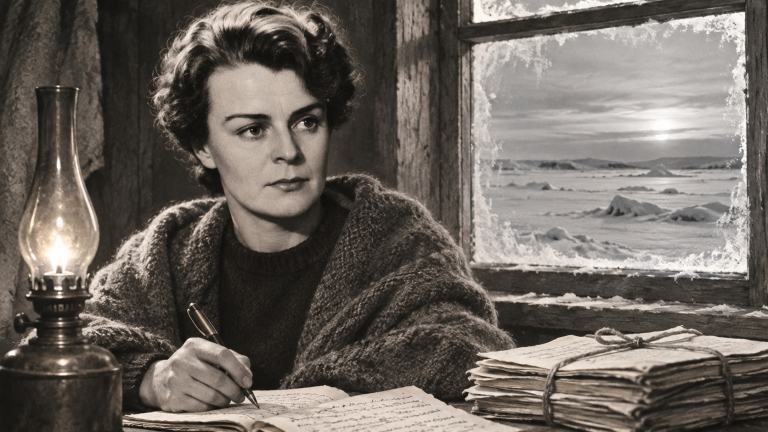
Chapter 1. A Childhood Interrupted
Dalia Grinkevičiūtė was born on 28 May 1927 in Kaunas, Lithuania, into an educated family. Her father, Juozas Grinkevičius, worked at the Bank of Lithuania. Dalia grew up in an environment where education, books, and cultural life were part of everyday experience.
She attended the Aušra Girls’ Gymnasium in Kaunas. Like many young people of her generation, she expected to complete her education and build a future in an independent Lithuania.
But in June 1940, Lithuania was occupied by the Soviet Union. Political arrests, nationalisation, and the persecution of people considered socially or politically undesirable transformed the country.
On the night of 14 June 1941, Soviet authorities began mass deportations from Lithuania. Fourteen-year-old Dalia, her mother Pranė, and her brother Juozas were taken from their home. Her father was arrested separately and sent to a prison camp in the northern Urals.
The family was torn apart. Dalia’s childhood ended during a single night.
Chapter 2. Beyond the Arctic Circle
Dalia and her mother and brother were initially deported to the Altai region. In 1942, they were transferred to Trofimovsk, an isolated settlement on the island of the same name in the Lena River delta, near the Laptev Sea.
The conditions were devastating. The region lay beyond the Arctic Circle, where long winters, extreme cold, hunger, disease, and exhausting labour determined everyday life.
The deportees were expected to survive with almost no resources. People who had previously been teachers, doctors, civil servants, and students were forced into hard physical work.
Dalia witnessed suffering that few people outside the Soviet system could imagine. Her father died in a labour camp in 1943. Her family had lost its home, its security, and much of its former life.
Yet Dalia continued to observe and remember. She noticed the details of everyday survival: the struggle to find food, the effects of hunger, the fragile solidarity between people, and the terrible vulnerability of children and the elderly.
These memories would later become the foundation of her writing.
Chapter 3. Escape, Loss, and a Hidden Manuscript
In February 1949, Dalia and her mother managed to escape from exile and return to Lithuania. They reached Kaunas, but they could not live openly. They were forced to hide, and Dalia cared for her increasingly ill mother.
During this period, she began writing an account of what she had witnessed in Siberia.
She understood that her testimony could be dangerous. In 1949–1950, she wrote her first extensive memoir in Kaunas. Before the authorities could seize it, she placed the manuscript in a glass jar and buried it in the garden of her parents’ former home.
In October 1950, Dalia was arrested again. Her mother died that year, and Dalia was once more separated from the life she had tried to rebuild.
She was imprisoned and subsequently sent back into exile. In 1953, she was deported to Yakutsk.
The manuscript remained buried, waiting for a time when its story could finally be heard.
Chapter 4. A Doctor Who Refused to Forget
In 1956, Dalia was released from exile and returned to Lithuania in 1957.
She continued her education and entered the Kaunas Medical Institute. Graduating in 1960, she became a doctor and worked at a hospital in Laukuva until 1974.
Medicine gave her an opportunity to care for others, particularly people who had experienced deportation and political persecution. She also collected and recorded the memories of former deportees.
But the Soviet authorities continued to regard her as a politically unreliable person. Her writing and her determination to preserve the truth brought her into conflict with the security services.
In 1974, she lost her position and her service apartment. Her life once again became uncertain.
She continued writing, reconstructing her memories and documenting the experience of exile. Because the first manuscript had disappeared, she created new versions, initially in Russian and later in Lithuanian.
Her testimony circulated outside official publishing channels. In 1979, a version of her account appeared in Russian samizdat in Moscow.
Chapter 5. The Words That Outlived the Silence
Dalia Grinkevičiūtė died in Kaunas on 25 December 1987. She did not live to see the full public recognition of her work.
In 1988, her memoirs about the Lithuanian deportees and their experiences near the Laptev Sea were published in Lithuania under the title Lietuviai prie Laptevų jūros — Lithuanians by the Laptev Sea.
The discovery of her original buried manuscript in 1991 added another extraordinary chapter to the history of her testimony. The glass jar had preserved a document that its author had feared would be destroyed.
Her writing became one of the most important literary and historical records of the Soviet deportations of Lithuanians. It combined the precision of documentary testimony with the emotional power of personal memory.
In 2021, her manuscript legacy was included in Lithuania’s national Memory of the World Register, recognising its importance for preserving historical memory.
Dalia Grinkevičiūtė had spent much of her life trying to protect the truth from being erased. Her words eventually travelled far beyond the country where she had first written them.
The girl deported at fourteen became one of Lithuania’s most important witnesses to the human cost of totalitarian rule.
Historical Note
Dalia Grinkevičiūtė (1927–1987) was a Lithuanian physician, writer, deportee, and dissident. She was deported with her family on 14 June 1941, first to the Altai region and later to Trofimovsk in the Arctic. After escaping in 1949, she wrote a memoir and buried the manuscript in a glass jar. Arrested again in 1950, she was subsequently exiled to Yakutsk. She returned to Lithuania in 1957, worked as a physician, and continued documenting the experiences of deportees.
Her memoirs were published in Lithuania in 1988. The original buried manuscript was discovered in 1991, and her manuscript legacy entered Lithuania’s national UNESCO Memory of the World Register in 2021.
This biography is based on historical records and published biographical research. The events and dates described are factual; no fictional episodes have been added.