
Chapter 1. A Young Artist in a Changing Lithuania
Vytautas Bičiūnas was born in Klovainiai, in the Šiauliai region of Lithuania, in 1893. He came from a family of modest means: his father was a locksmith. From an early age, Bičiūnas showed an interest in art and education.
Between 1903 and 1912, he attended Šiauliai Gymnasium. He then continued his studies at the Kazan Art School in Russia, where he studied painting and architecture. His education gave him a broad artistic foundation that would later shape his work as a painter, theatre designer, writer, and cultural organiser.
During the First World War, he was mobilised into the Russian Imperial Army. He left military service in early 1918 and became involved in Lithuanian public and cultural activities in Petrograd. He worked with the Supreme Lithuanian Council and contributed to the preparation of an ethnographic map of Lithuania.
In May 1918, he returned to Lithuania. The country was moving towards independence, and Bičiūnas became part of a generation trying to build its cultural and political institutions.
Chapter 2. Theatre, Art, and the New Republic
At the end of 1918, Bičiūnas moved to Vilnius, where he worked in the Lithuanian government’s Department of Arts, heading its Applied Arts section. He subsequently held several public positions, including work in government departments responsible for national defence, religious affairs, and state administration.
His artistic interests, however, remained central to his life.
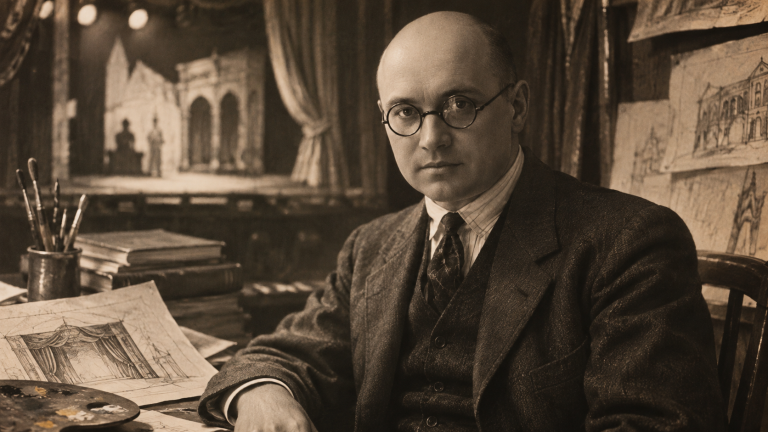
In 1920, he became involved with the Vilkolakis Theatre in Kaunas, led by Antanas Sutkus. He worked as an actor, playwright, and scenographer, combining performance with the visual design of theatrical productions.
He also worked with the National Theatre and participated in art exhibitions. His activities extended beyond the stage: he illustrated books, wrote criticism, and helped develop the cultural life of the young Lithuanian Republic.
Bičiūnas was not only an observer of the new state. He was one of the people actively building its institutions. Between 1920 and 1923, he represented Christian Democratic political circles in the Constituent Assembly and the First Seimas.
His life connected several worlds: theatre, painting, literature, education, and public service.
Chapter 3. The Man Who Built Theatres and Preserved History
After 1923, Bičiūnas increasingly devoted himself to teaching and cultural work in Kaunas, which had become Lithuania’s temporary capital.
He founded two theatre companies: Vytis, active in 1927–1928, and Žvaigždikis, active in 1931–1932. Through these groups, he continued experimenting with theatrical performance and bringing stage productions to audiences.
He wrote poetry, short stories, plays, and literary criticism. His collection Mano apysakos (My Stories) appeared in 1928. Among his dramatic works was Žalgiris, published in 1932.
Bičiūnas also made an important contribution to the study of Lithuanian culture. In 1927, he published a monograph about the artist and composer Mikalojus Konstantinas Čiurlionis, one of the first separate books devoted to Čiurlionis’s life and work.
In 1930, he published Kaunas, 1030–1930, a historical account prepared for the city’s nine-hundredth anniversary. The book traced the development of Kaunas and became an early substantial survey of the city’s history.
His interests also included folk art, education, and national heritage. In 1936, he published Liaudies teatras (People’s Theatre), a practical guide for amateur theatre groups.
By the end of the 1930s, Bičiūnas had become an established figure in Lithuanian cultural life.
Chapter 4. 14 June 1941: The Arrest
The Soviet occupation of Lithuania in June 1940 brought a fundamental change to the lives of its citizens. Political institutions were dismantled, private property was confiscated, and people considered dangerous to the new regime were subjected to surveillance, arrest, and deportation.
Bičiūnas had been involved in the independent Lithuanian state as a politician, public servant, and cultural figure. His previous public activities placed him among those targeted by Soviet repression.
On 14 June 1941, Soviet security authorities arrested him. He was taken from Lithuania and sent to the North Ural labour-camp system.
His wife, Natalija, and their children were deported separately to the Altai region. The family was divided by the Soviet deportation operation, and they faced different forms of captivity and forced displacement.
Bičiūnas was imprisoned in the Sverdlovsk region. Archival records identify him in the Sevurallag camp system, including the Gari camp.
On 4 November 1942, he was executed in Sverdlovsk by Soviet authorities.
His family remained in exile. His wife and surviving children were eventually released and returned to Lithuania in the years 1956–1958. One of his sons, Rimantas Virgilijus, died in exile.
Chapter 5. The Memory of an Artist
For decades, the full story of Bičiūnas and his family belonged to the history of Soviet repression, a history that could not be openly discussed during the Soviet period.
In 1989, Vytautas Bičiūnas was rehabilitated. The rehabilitation formally acknowledged the injustice of the political persecution against him.
His memory was later restored in the city where he had spent much of his professional life. On 13 September 1993, a memorial plaque with a bas-relief was unveiled at Vytauto Avenue 93 in Kaunas, the house where he had lived between 1938 and 1941.
The plaque commemorates him as a member of the Constituent Seimas, writer, theatre artist, and painter who was shot by the Bolsheviks in Sverdlovsk.
Today, Bičiūnas is remembered as a multifaceted cultural figure whose work helped shape Lithuanian theatre, art criticism, historical writing, and public education during the first decades of independence.
His life was interrupted by political violence, but his contribution to Lithuanian culture remains part of the country’s historical memory.
Historical Note
Vytautas Bičiūnas (1893–1942) was a Lithuanian writer, playwright, painter, theatre director, scenographer, art critic, and politician. He studied at the Kazan Art School, worked in the cultural institutions of independent Lithuania, participated in the Constituent Assembly and First Seimas, and founded the theatre companies Vytis and Žvaigždikis.
On 14 June 1941, Soviet authorities arrested him and sent him to the North Ural labour camps. His wife and children were deported separately to the Altai region. He was executed in Sverdlovsk in 1942 and rehabilitated in 1989.
Sources differ on the exact date of his execution: some give 30 October 1942, while the Lithuanian Seimas biography and archival records give 4 November 1942. This biography follows the archival date of 4 November.
The account is based on historical and archival records. No fictional events have been added.