
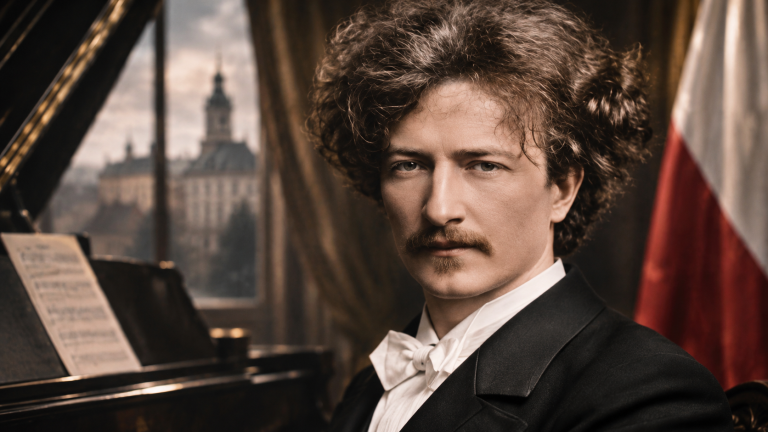
Chapter 1. A Childhood Shaped by Music and History
Ignacy Jan Paderewski was born on 6 November 1860 in Kurylivka, in the Podolia region, then part of the Russian Empire and now in Ukraine. He grew up in a Polish-speaking cultural environment at a time when Poland had been divided between neighbouring powers and no longer existed as an independent state.
His mother died when he was an infant, and he was raised by relatives. Music became an important part of his childhood. His father played the violin, and young Ignacy showed an early interest in the piano.
In 1872, he entered the Warsaw Music Institute. After graduating in 1878, he remained there as a piano teacher. He later continued his musical education in Berlin and Vienna, studying composition and piano.
His early life was marked by two ambitions: to become an accomplished musician and to contribute to the cultural life of a nation whose independence had been taken away.
Chapter 2. The Musician Who Conquered the World
Paderewski’s international career began to flourish in the late 1880s. His Paris debut in 1888 brought him widespread attention, and his performances soon attracted audiences across Europe and beyond.
His distinctive appearance, extraordinary technique, and expressive interpretations made him one of the most celebrated pianists of his generation. He toured extensively in Europe and the United States, performing before enormous audiences.
He was also a composer. Among his best-known works are the Piano Concerto in A minor, the Polish Fantasy, and the opera Manru, which premiered in Dresden in 1901 and was later performed at the Metropolitan Opera in New York.
Paderewski’s fame gave him something few political activists possessed: access to influential people and the attention of international audiences.
He increasingly used his concerts and public appearances to speak about Poland. For him, music and national identity were connected. His artistic success became a means of drawing attention to the fate of his homeland.
Chapter 3. Making the Polish Cause Heard
During the First World War, Paderewski devoted much of his energy to the Polish independence movement.
He settled in the United States in 1913 and became one of the most prominent advocates of the Polish cause among Americans. He addressed public meetings, organised support, and helped raise funds for Polish relief efforts.
In 1917, he joined the Polish National Committee in Paris and became its representative in the United States.
One of his most important political achievements was his influence on American public opinion and his personal contacts with President Woodrow Wilson and members of the American administration.
On 8 January 1918, Wilson presented his Fourteen Points, including the principle that an independent Polish state should be established with access to the sea. Paderewski’s advocacy was an important part of the wider campaign that helped make Polish independence an international issue.
He did not act alone: Polish political leaders, organisations, diplomats, and communities across the world all contributed to the effort. But Paderewski’s international reputation made him an exceptionally effective representative of the cause.
His work demonstrated that cultural influence could become a powerful instrument of political action.
Chapter 4. From Concert Hall to Government
Paderewski returned to Poland at the end of 1918. His arrival in Poznań on 26 December helped inspire a wave of patriotic enthusiasm that contributed to the outbreak of the Greater Poland Uprising.
On 16 January 1919, he became Prime Minister and Minister of Foreign Affairs of the newly restored Polish state.
His government faced enormous challenges. Poland had to establish functioning institutions, defend its borders, bring together territories that had been governed by different empires, and secure international recognition.
Paderewski represented Poland at the Paris Peace Conference alongside Roman Dmowski. On 28 June 1919, he signed the Treaty of Versailles on behalf of Poland.
His premiership ended in December 1919. Although he left government, he continued to support Poland and remained an influential public figure.
In the following years, he returned to international concert life. He also continued philanthropic activities, supporting educational, cultural, and charitable initiatives.
Chapter 5. A Statesman in Exile
Paderewski did not remain politically indifferent during the years that followed.
After Józef Piłsudski’s May Coup of 1926, Paderewski became increasingly critical of the direction of Polish political life. In 1936, he supported the Morges Front, an opposition alliance that brought together several prominent political figures.
When Germany invaded Poland in September 1939, Paderewski once again became involved in the struggle for his country’s future.
In December 1939, he became chairman of the Polish National Council, an advisory body associated with the Polish government-in-exile. From abroad, he continued to represent Poland and support its cause during the Second World War.
His health was declining, but he continued working until the end of his life.
Ignacy Jan Paderewski died in New York on 29 June 1941. He was initially buried at Arlington National Cemetery, where his remains stayed until 1992, when they were transferred to Poland and reburied in Warsaw’s Archcathedral Basilica of St John the Baptist.
His life connected the concert hall, the diplomatic table, and the political struggle for independence. He demonstrated that an artist could become a statesman without abandoning the art that had first given him a voice.
Historical Note
Ignacy Jan Paderewski (6 November 1860 – 29 June 1941) was a Polish pianist, composer, philanthropist, diplomat, and statesman.
Born in Kurylivka in Podolia, now Ukraine, he studied music in Warsaw, Berlin, and Vienna. He became an internationally renowned pianist and composer, using his fame to advocate for Polish independence during the First World War.
He represented the Polish National Committee in the United States, worked to secure international support for an independent Poland, and became Prime Minister and Minister of Foreign Affairs in January 1919. He signed the Treaty of Versailles on behalf of Poland on 28 June 1919.
During the Second World War, he chaired the Polish National Council in exile. He died in New York in 1941 and was reburied in Warsaw in 1992.