
Chapter 1. From Krupki to the World of Ideas
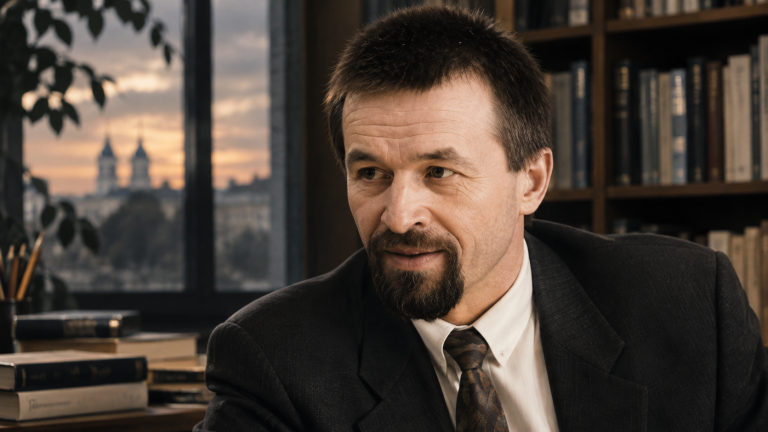
Anatol Sciapanavich Krasouski was born in 1952 in Krupki, a town in the Minsk Region of Belarus. He grew up in a country where education and professional achievement offered a path into public and intellectual life.
Krasouski studied at the Faculty of Physics of Belarusian State University. Yet his interests extended beyond the natural sciences. He became a teacher, researcher, and author, eventually receiving a Candidate of Philosophical Sciences degree.
His academic work focused on questions of social development, education, family relationships, and the values that shaped young people’s lives.
He was among the contributors to educational materials on the ethics and psychology of family life. He also wrote scientific papers and textbooks, combining academic research with practical educational work.
For Krasouski, knowledge was not something that belonged only in universities. He believed that ideas could influence everyday life, relationships, and the way people understood their responsibilities to one another.
Chapter 2. A Business Built Around Publishing
In the early 1990s, as the Soviet Union collapsed and Belarus entered a new period of independence, Krasouski moved from academic work into business.
He became a successful entrepreneur and established publishing activities. Among the magazines associated with his publishing work were I + I and Ideal.
His business interests expanded into other areas, but publishing remained an important part of his public identity. It allowed him to participate in the emerging media environment of a country undergoing profound political and economic change.
Krasouski’s daughter later recalled that her father did not enter business simply to become wealthy. His publishing work grew naturally from his earlier intellectual and educational interests.
The transition from the Soviet system to an independent Belarus created opportunities for private enterprise, independent publishing, and new forms of civic activity. Krasouski became one of the people who helped support this changing environment.
Chapter 3. A Quiet Patron of Civil Society
Krasouski was also known for his charitable activities.
He provided financial assistance to the Belarusian Children’s Fund, the cultural initiative Artists of Culture to Children, a theatre and film acting school, and the Berezinsky Biosphere Reserve.
He also supported a number of public organisations, including politically independent initiatives.
His philanthropy was not primarily a public-relations exercise. Accounts of his life describe him as someone who often preferred to help without advertising his contributions.
His support for education, culture, children, and independent public organisations reflected a broader understanding of business responsibility.
In a society where independent civic institutions were often financially vulnerable, private support could make a meaningful difference.
Krasouski’s contribution was not limited to the companies he managed or the publications he produced. He also helped create space for people and organisations working outside direct state control.
Chapter 4. Friendship and Political Pressure
Krasouski was a close friend and supporter of Viktar Hanchar, a lawyer and politician who had once served in Alexander Lukashenko’s government but later became one of his prominent critics.
The two men shared concerns about the political direction of Belarus, particularly after the controversial constitutional referendum of 1996, which substantially expanded presidential powers.
Krasouski supported Hanchar and maintained connections with organisations and people who opposed the growing concentration of political authority.
In August 1999, Krasouski was reportedly arrested and held in a detention facility on accusations described by opposition sources as politically motivated. The circumstances of this episode were part of the broader pressure surrounding his public and political connections.
By September 1999, Belarus was approaching a serious political confrontation. Opposition figures were challenging the extension of Lukashenko’s presidential term and organising alternative political initiatives.
Krasouski was not simply a businessman who happened to know an opposition politician. His own support for independent public life had made him part of the country’s political landscape.
Chapter 5. The Disappearance
On 16 September 1999, Krasouski and Viktar Hanchar spent the evening together in Minsk.
Earlier that day, Krasouski had spoken with his wife, Irina. They planned to celebrate her belated birthday at home with coffee and cake. He told her that he would first visit a sauna with Hanchar and then return.
At approximately 10:35 p.m., the two men left the sauna on Fabryčnaja Street and got into Krasouski’s Jeep Cherokee.
They never arrived home.
Investigators later reported finding broken vehicle-light components, braking marks, signs that a vehicle had struck a tree, and traces of blood near the area. The evidence supported the conclusion that the men had been forcibly taken away.
Their disappearance became one of the most serious unresolved human rights cases in Belarus.
Human rights organisations, international institutions, and the families of the missing repeatedly called for an independent investigation. Allegations concerning the involvement of state security structures were raised, but the full circumstances and responsibility have never been established through a conclusive independent judicial process.
A 2024 submission to the United Nations Working Group on Enforced or Involuntary Disappearances identified Krasouski’s case as one of the election-related enforced disappearances of 1999. The report highlighted the absence of an independent and effective investigation and the continuing lack of answers for the families.
Krasouski’s body has never been found. His wife and daughters have continued to seek the truth about what happened to him.
His story is a reminder that civil society is sustained not only by politicians and public speakers, but also by publishers, educators, entrepreneurs, and people who quietly support independent institutions.
Historical Note
Anatol Sciapanavich Krasouski (1952–disappeared 16 September 1999) was a Belarusian teacher, philosopher, publisher, entrepreneur, and philanthropist.
He graduated from the Faculty of Physics at Belarusian State University, received a Candidate of Philosophical Sciences degree, and contributed to educational publications. In the 1990s, he became an entrepreneur and publisher, associated with magazines including I + I and Ideal.
He supported cultural, educational, charitable, and independent civic organisations in Belarus. He was a close friend and supporter of opposition politician Viktar Hanchar.
On 16 September 1999, Krasouski and Hanchar disappeared in Minsk after leaving a sauna on Fabryčnaja Street. Their bodies have never been found, and the circumstances of their disappearance remain unresolved.
Date of birth note: Available sources give different dates in May 1952. A contemporary United Civic Party publication gives 17 May, while other biographical records give 7 or 12 May. The precise date should be treated as unconfirmed until verified against a primary source.