
Chapter 1. A Boy from the Lithuanian Countryside
Kazys Inčiūra was born on 25 September 1906 in Vidugiriai, a village in the northeastern Lithuanian countryside. The landscapes, stories, and traditions of his homeland would remain important to his imagination throughout his life.
From an early age, Inčiūra was drawn to words and performance. He attended Panevėžys Boys’ Gymnasium, where teachers encouraged his interest in literature and the arts. One of the educators who influenced the cultural life around him was the writer Julijonas Lindė-Dobilas, who helped students explore their own literary voices.
Inčiūra began publishing his writing in the 1920s. His early poems reflected a romantic attachment to nature, Lithuanian folklore, and the emotional world of ordinary people. He was interested not only in what people said, but also in the feelings hidden beneath their words.
In 1925, he moved to Kaunas and entered the Lithuanian University, later known as Vytautas Magnus University. He studied Lithuanian language and literature while continuing to develop his literary ambitions.
For Inčiūra, writing was never simply a private activity. He wanted words to reach people—to be read, spoken aloud, and brought to life.
Chapter 2. The Poet Who Stepped onto the Stage
Literature was only one part of Inčiūra’s artistic world. He also dreamed of becoming an actor and studied at the State Theatre’s acting school, graduating in 1930.
The stage offered him another way to explore human experience. A poem could suggest a feeling through rhythm and imagery; an actor could express it through a voice, a movement, or a moment of silence.
Inčiūra worked as a theatre actor in the early 1930s and later performed in Vilnius. Across his theatrical career, he played more than thirty roles. His experience on stage deepened his understanding of dialogue, dramatic tension, and the relationship between a performer and an audience.
At the same time, he continued writing poetry, prose, and plays. Collections such as Su jaunyste (With Youth, 1928), Tyliųjų saulėlydžių žemėj (1930), and Padavimai (Legends, 1936) reflected his interest in homeland, nature, folklore, and personal feeling.
He was also drawn to traditional legends and stories, reshaping inherited motifs for modern readers. His literary imagination moved between the familiar landscape of Lithuania and the timeless world of myth.
The theatre taught him that a story could live in a person’s voice. His poetry showed that even a quiet voice could carry an entire world.
Chapter 3. A Voice Across the Airwaves
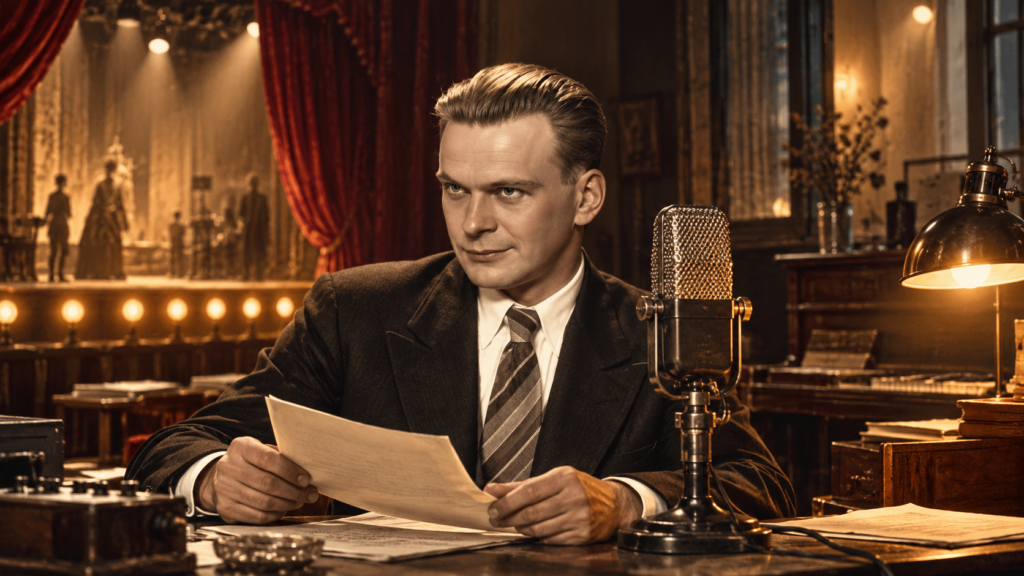
In 1934, Inčiūra began working as a radio announcer. His professional life connected him with both Kaunas and Vilnius, and radio gave his voice a reach that the theatre could not always provide.
He read news, presented programmes, organised literary broadcasts, and recited poetry. Radio allowed literature to enter homes far from theatres and libraries. A listener did not need to see the speaker to be drawn into a poem or a story.
Inčiūra remembered literary evenings and poetry programmes as meaningful parts of his broadcasting work. His voice became associated with public cultural life during a period when Lithuanian literature, theatre, and broadcasting were developing rapidly.
Yet the political world around him was becoming increasingly dangerous. Lithuania experienced successive occupations during the Second World War, and public life was transformed by the struggle between competing regimes and ideologies.
Inčiūra continued working in literature and performance. His writing and broadcasting history later became part of the case brought against him by Soviet security authorities. The authorities accused him of anti-Soviet activity, including writing and possessing material they considered hostile to the regime.
The artist who had spent years speaking to audiences over the radio would soon be removed from public life. His own voice would be silenced, but the work he had created would not disappear.
Chapter 4. Five Years Beyond the Familiar World
In 1951, Soviet authorities arrested Inčiūra and sentenced him to twenty-five years of imprisonment. He was sent to a labour camp in the Sverdlovsk region of the Soviet Union, in the Ural area.
The sentence separated him from the landscapes, theatres, libraries, and audiences that had shaped his life. For a writer and actor, imprisonment meant more than losing freedom: it also meant losing the ordinary conditions in which art could be created and shared.
The full experience of his imprisonment cannot be reconstructed from a handful of biographical facts. It is important not to invent conversations or private thoughts on his behalf. What is documented is that he endured years in the Soviet camp system and did not return to Lithuania until 1956.
His release came earlier than the original sentence required. Accounts of his life connect the reduction of his punishment with the intervention of the Lithuanian writer Antanas Žukauskas-Vienuolis.
Inčiūra returned to a homeland that had changed profoundly. The literary world he had known before the war had been reshaped by Soviet control, censorship, and political repression. Some writers had been killed, others imprisoned or exiled, and many had to negotiate the boundaries of what could be published.
His return did not erase the years of captivity. It did, however, give him another opportunity to write.
Chapter 5. The Words That Remained
After returning to Lithuania, Inčiūra resumed his literary work. He published poetry and continued writing plays, prose, and works inspired by folklore. In 1967, he was readmitted to the Lithuanian Writers’ Union.
His later career unfolded under Soviet rule, where writers often faced pressure to conform to official ideological expectations. Some of his published work reflected the conventions of the period, while other writings preserved personal memories, spiritual concerns, and themes rooted in Lithuanian cultural tradition.
A number of his manuscripts and poems appeared only after his death. These posthumous publications helped readers encounter parts of his creative legacy that had not been fully visible during his lifetime.
Kazys Inčiūra died in Vilnius on 30 November 1974. He was buried in Antakalnis Cemetery. His grave bears a memorial inscription recalling the sadness of unfinished books and unwritten verses—a poignant image for a writer whose life had been interrupted by imprisonment.
His story is not the story of an execution in 1937. It is the story of a Lithuanian artist whose career was broken by Soviet repression, whose freedom was taken away, and who nevertheless returned to literary work.
The voice that once travelled across the airwaves could not restore the years he had lost. But his poems, plays, memories, and manuscripts remained—a record of a life shaped by art, political violence, and the difficult work of beginning again.
Historical Note
Kazys Inčiūra (1906–1974) was a Lithuanian poet, prose writer, playwright, actor, and radio announcer. Born in Vidugiriai, he studied at the Lithuanian University in Kaunas and trained at the State Theatre’s acting school. He worked in theatre and radio in Kaunas and Vilnius, was arrested by Soviet authorities in 1951, sentenced to twenty-five years, and imprisoned in the Sverdlovsk region. He returned to Lithuania in 1956 and died in Vilnius in 1974.
Inčiūra was not executed in 1937. His story belongs to the wider history of Soviet repression and imprisonment, and should be distinguished from the biographies of writers murdered during the Great Terror of 1937–1938.
Sources
- Visuotinė lietuvių enciklopedija — Kazys Inčiūra
https://www.vle.lt/straipsnis/kazys-inciura/ - Panevėžys Region History Portal — Inčiūra Kazys
https://paneveziokrastas.pavb.lt/personalija/inciura-kazys/ - Lithuanian Central State Archives — Kazys Inčiūra
https://lyavaizdai.archyvai.lt/vaizdai/3/p6560/doc4907 - Maironis Lithuanian Literature Museum — Kazys Inčiūra: “Mane iš mažų dienų riša plunksna ir scena”
https://maironiomuziejus.lt/parodos/kazys-inciura-virtuali-paroda/ - Troškūnai Kazys Inčiūra Gymnasium — Rašytojas, kurio vardu pavadinta Troškūnų gimnazija
https://troskunai.anyksciai.lm.lt/apie-mus/kazys-inciura/
