
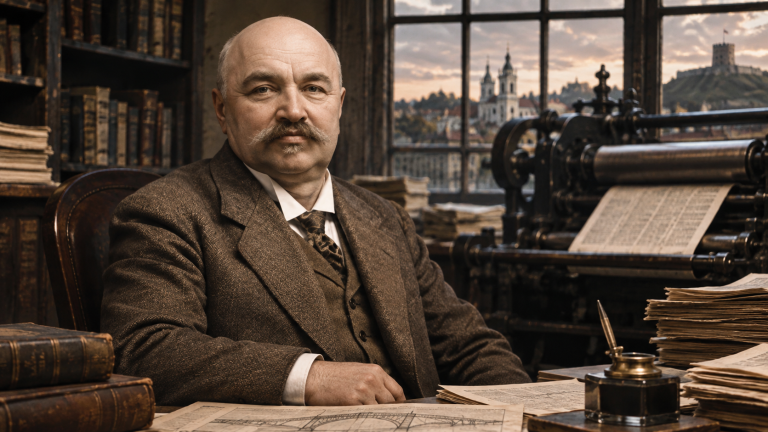
Chapter 1. A Boy from Mediniai
Petras Vileišis was born on 25 January 1851 in the village of Mediniai, in the Pasvalys region of present-day Lithuania. He grew up in a family of free peasants, at a time when Lithuanian cultural and public life was shaped by the political structures of the Russian Empire.
His education took him first to Panevėžys and then to the Šiauliai Boys’ Gymnasium, from which he graduated with a gold medal in 1870. He continued his studies at the University of St Petersburg, choosing the Faculty of Physics and Mathematics. He graduated in 1874 and later completed his engineering education at the St Petersburg Institute of Railway Engineers in 1881.
His studies gave him the technical knowledge that would define his professional career. But they also brought him into contact with other Lithuanian students who were concerned about the future of their language and culture.
While in St Petersburg, Vileišis took part in discussions about Lithuanian literature and the restrictions imposed on Lithuanian publications. He and his friends produced a handwritten newspaper called Kalvis melagis.
For Vileišis, education was never simply a means of personal advancement. He increasingly saw knowledge, publishing, and practical skills as instruments through which a society could develop and become more self-reliant.
Chapter 2. Bridges, Railways, and Independence of Mind
After completing his engineering studies, Vileišis began working in the railway administration of the Russian Empire. He became a specialist in engineering structures and took part in the construction of railway lines and bridges across the empire.
His work took him to different regions, including the railway projects connecting Vilnius with Rovno and the construction of lines in the Volga and Ural regions. In 1883, he travelled to Belgium to study modern techniques for constructing iron railway bridges using caissons.
He later established his own engineering business and became a successful contractor. Over the course of his career, he designed and built numerous bridges and contributed to the expansion of railway infrastructure. He was regarded as a skilled and reliable engineer.
This professional success gave him something that few Lithuanian cultural activists of his time possessed: financial resources.
Vileišis did not treat his earnings simply as private wealth. He saw them as a means of supporting the development of Lithuanian education, publishing, and public life.
His engineering career and cultural commitments were closely connected. The bridges he built joined physical places, while his publishing work helped connect people through a shared written language and access to knowledge.
Chapter 3. Publishing in a Time of Prohibition
In the nineteenth century, the Russian imperial authorities imposed a ban on Lithuanian publications printed in the Latin alphabet. The restrictions, introduced in 1864, severely limited the development of Lithuanian-language publishing and education.
Books and newspapers printed in Lithuanian using Latin letters were produced abroad and brought into the country through networks of distributors and book carriers. The ban made ordinary cultural activity a matter of persistence and, often, personal risk.
Vileišis supported Lithuanian publishing during this period. He wrote educational booklets, translated texts, and prepared practical publications on agriculture, mathematics, physics, geography, history, and other subjects.
He was among the early authors of secular Lithuanian works on science and technology and helped develop Lithuanian technical terminology. His publications were intended not only for scholars but also for ordinary readers who needed useful knowledge in their own language.
He also supported the periodicals Aušra and Varpas, contributing financially and intellectually to the Lithuanian national movement.
His approach was practical: a nation needed schools, books, newspapers, technical knowledge, and people able to use them. Cultural renewal, in his view, required both intellectual work and economic development.
Chapter 4. Vilnius and the Lithuanian Public Sphere
After returning to Lithuania, Vileišis settled in Vilnius in the late nineteenth century. The city became the centre of his most important cultural and publishing activities.
In 1900, he established an ironworks that employed Lithuanian workers, engineers, and office staff. He also brought together prominent Lithuanian public figures and supported organisations working to strengthen Lithuanian cultural life in the city.
Following the lifting of the Lithuanian press ban in 1904, Vileišis received permission to establish a printing house. He founded a Lithuanian publishing operation and began producing books and newspapers.
In December 1904, he launched Vilniaus žinios, the first legal Lithuanian daily newspaper. He was its publisher and editor. The newspaper became an important platform for public discussion and information in Lithuanian, although financial difficulties eventually led to its closure in 1909.
Vileišis also supported the establishment of the Lithuanian Scientific Society, founded in 1907, and the Lithuanian Art Society. His home in Vilnius became a centre of Lithuanian cultural activity and later housed important organisations.
He invested much of his accumulated capital in these projects. The cultural work he considered essential proved expensive, and he eventually exhausted his resources and accumulated debts.
In 1908, he left Vilnius to return to engineering work in the Russian Empire. His departure did not erase the importance of what he had helped establish: Lithuanian publishing and organised cultural life had gained institutions, experience, and a stronger public presence.
Chapter 5. Returning to an Independent Lithuania
After years of engineering work in the Caucasus and Georgia, where he supervised railway construction and the building of bridges and tunnels, Vileišis returned to Lithuania in February 1921.
He settled in Kaunas, which had become the provisional capital of the newly independent Lithuanian Republic. His experience as an engineer and public figure was now valuable to the state.
In 1922, he became Minister of Transport in the government of Prime Minister Ernestas Galvanauskas. He served in the ministry until 1923 and continued contributing to engineering and public affairs.
The University of Lithuania recognised his long-standing contribution to Lithuanian cultural and educational life, awarding him an honorary doctorate in 1923. He was also honoured by the Lithuanian engineering community.
Vileišis died in Palanga on 12 August 1926. He was initially buried in Kaunas Cathedral Basilica and later reinterred in Rasos Cemetery in Vilnius, where many prominent figures of Lithuanian history are buried.
His legacy cannot be reduced to one profession. He was an engineer who built bridges, an entrepreneur who created industrial enterprises, an author of educational books, a publisher who helped establish a Lithuanian-language press, and a patron who invested his personal wealth in the cultural development of his nation.
Petras Vileišis believed that a society could become stronger through education, economic initiative, and cultural work. Much of his life was devoted to turning that belief into practical institutions that would outlast him.
Historical Note
Petras Vileišis (25 January 1851 – 12 August 1926) was a Lithuanian engineer, industrialist, publisher, author, translator, educator, and national movement organiser. Born in Mediniai, he studied in Panevėžys, Šiauliai, and St Petersburg before pursuing a successful career in railway and bridge construction across the Russian Empire.
He used his professional earnings to support Lithuanian-language publishing and education during the period of the Lithuanian press ban. After settling in Vilnius, he established an ironworks, founded a printing house, and published Vilniaus žinios, the first legal Lithuanian daily newspaper, from 1904 to 1909. He also supported Lithuanian cultural and scientific organisations.
After returning to Lithuania in 1921, he lived in Kaunas and served as Minister of Transport in 1922–1923. He died in Palanga and was later reburied in Rasos Cemetery in Vilnius.
This biography is based on Lithuanian encyclopaedic, museum, library, and academic sources.