
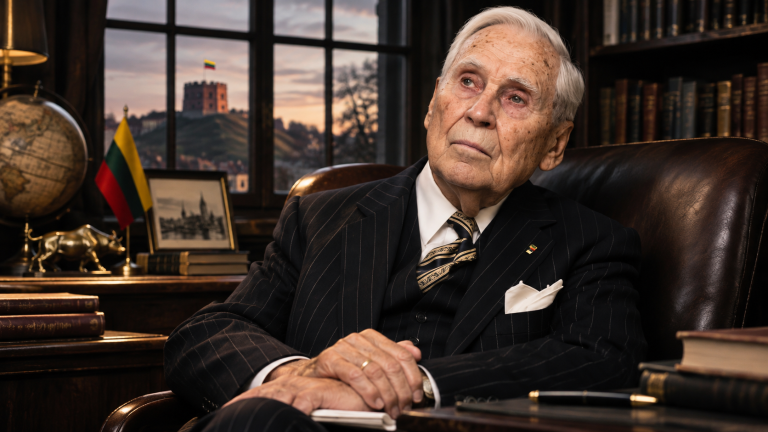
Chapter 1. Born into a Family of Exile
Juozas Petras Kazickas was born on 16 April 1918 in Čiornaja Padina, in the Saratov region of Russia. His birthplace was far from Lithuania, but his family’s history was deeply connected to the struggle for Lithuanian freedom.
His grandparents had participated in the January Uprising of 1863 against the Russian Empire. In 1883, they were deported to Russia, where their descendants established a life far from their ancestral homeland. Juozas was born into this family of exile.
In 1922, when he was four years old, his parents returned with him to Lithuania. The family settled in Geltonpamūšis, in the Pasvalys region. Growing up in independent Lithuania, Kazickas experienced a country rebuilding its institutions and developing its education, economy, and national identity.
He attended school in Pasvalys and graduated from the Petras Vileišis Gymnasium in 1937. He then began studying economics at Vytautas Magnus University in Kaunas. His education continued at Vilnius University, where he completed his economics studies in 1942.
Vilnius also became important in his personal life. There he met Aleksandra, who would become his wife. Their relationship began during a period of growing uncertainty, as Lithuania experienced successive occupations and the upheavals of the Second World War.
Chapter 2. War, Occupation, and the Road into Exile
The Second World War transformed the country in which Kazickas had grown up. Lithuania lost its independence in 1940, first experiencing Soviet occupation, followed by Nazi German occupation from 1941, and then the return of Soviet rule in 1944.
During the German occupation, Kazickas worked in the Vilnius municipal administration, heading its department responsible for municipal enterprises. He completed his university education in 1942.
In 1944, as the Soviet army advanced towards Lithuania, Kazickas left the country with his wife Aleksandra and their young daughter. The family went to Germany, joining the large number of Lithuanians displaced by war and occupation.
Their departure was not a planned business journey or an ordinary decision to seek opportunities abroad. It was a consequence of the political and military situation. Like many Lithuanian refugees, they faced an uncertain future, separation from their homeland, and the challenge of rebuilding family life in another country.
The family eventually settled in the United States in 1947. Lithuania remained under Soviet rule, and returning home was not a realistic option for those who feared the consequences of the occupation.
Chapter 3. Building a New Life in America
In the United States, Kazickas continued his education and professional development. In 1951, he earned a doctorate in economics from Yale University. He subsequently taught at Yale until 1972 and also worked in academic and advisory roles.
His professional interests extended beyond university life. He worked as a consultant for American government departments, including the Department of Defense and the Department of State, and advised international companies and political leaders.
In 1951, he established Neris, a company involved in coal exports. He later expanded into international trade, including the coal and oil industries, and built relationships with major corporations, financial institutions, and governments.
His business career brought him considerable success. He became a respected international businessman and investor, working with companies such as Coca-Cola, Exxon, Columbia Gas, and other major organisations.
Yet his success in America did not mean that he had abandoned his Lithuanian identity. During the decades of Soviet occupation, Kazickas and his wife Aleksandra supported Lithuanian cultural activities and helped maintain connections among members of the Lithuanian diaspora.
Their home became a meeting place for people concerned with preserving Lithuanian language, culture, traditions, and the hope of national independence. Kazickas also took an active role in the Lithuanian Foundation in Chicago, serving on its board for many years.
For him, economic success was not an end in itself. It created opportunities to support a community whose homeland remained under foreign rule.
Chapter 4. Helping Lithuania Return to the World
The emergence of the Lithuanian independence movement in the late 1980s created new possibilities. As Sąjūdis gathered public support and Lithuania moved towards the restoration of statehood, Kazickas became actively involved in efforts to strengthen the country’s international position.
He used his business experience and personal relationships to connect Lithuanian representatives with influential political and economic figures in the United States and Western Europe. He helped organise meetings and encouraged international attention to Lithuania’s aspirations for independence.
When Lithuania restored its independence on 11 March 1990, the country faced enormous economic challenges. It had to establish functioning institutions, develop international relations, attract investment, and move away from the Soviet economic system.
Kazickas returned to Lithuania after approximately 35 years abroad. In 1991, he helped establish Litcom, a private telecommunications company that later became known as Omnitel. It was among the first private-capital telecommunications ventures in the Baltic States.
He also encouraged major international investors to enter the Lithuanian market. Companies such as Coca-Cola, Philip Morris, Motorola, and Williams became associated with the investment opportunities he helped bring to the country.
His contribution was not limited to business transactions. He advised Lithuanian leaders, helped build international contacts, and supported the development of a modern economy.
The experience he had gained abroad became a resource for a country that was once again determining its own future.
Chapter 5. Wealth as a Responsibility
In the later decades of his life, Kazickas continued supporting Lithuania through philanthropy, education, culture, and social initiatives.
Together with his wife Aleksandra, he established a family tradition of giving back. Their support extended to Lithuanian educational institutions, cultural organisations, scientific initiatives, and social projects.
In 1998, the Kazickas Family Foundation was established in the United States. It later expanded its activities in Lithuania, continuing the family’s commitment to education, healthcare, culture, and community development.
Kazickas received numerous Lithuanian honours for his contributions to the country. His work was recognised not only as that of a successful businessman but also as that of a person who helped strengthen Lithuania’s restored independence and international presence.
He died on 9 July 2014 in East Hampton, New York, at the age of 96.
His life began in a family shaped by deportation after the 1863 uprising. He grew up in independent Lithuania, experienced war and occupation, rebuilt his life in exile, and eventually used his international experience and resources to support the country to which his family had returned generations earlier.
Juozas Kazickas’s story is one of continuity across generations: the memory of a lost homeland, the preservation of national identity abroad, and the practical work of helping an independent Lithuania build its future.
Historical Note
Juozas Petras Kazickas (16 April 1918 – 9 July 2014) was a Lithuanian-American economist, businessman, public figure, and philanthropist. Born in Čiornaja Padina, Russia, to a Lithuanian family descended from participants in the 1863 uprising who had been deported by the Russian Empire, he returned to Lithuania with his parents in 1922.
He studied economics at Vytautas Magnus University and Vilnius University, graduating in 1942. He left Lithuania with his family in 1944, settled in the United States in 1947, and earned a doctorate from Yale University in 1951.
Kazickas built an international business career and remained active in Lithuanian diaspora organisations. During the movement for independence, he helped connect Lithuanian leaders with international political and business figures. After Lithuania restored independence, he returned and helped establish Litcom, later known as Omnitel, and attracted foreign investment. Together with his wife, he supported Lithuanian cultural, educational, and social initiatives through philanthropy and the Kazickas Family Foundation.
This biography is based on Lithuanian encyclopaedic, national library, historical, and family foundation sources.