
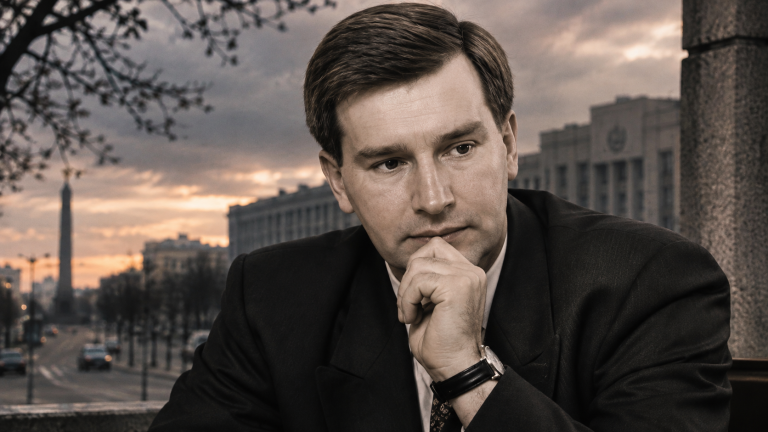
Chapter 1. A Young Lawyer from Radzichava
Viktar Iosifavich Hanchar was born on 7 September 1957 in Radzichava, a village in the Slutsk district of the Minsk region, Belarus. He grew up in a rural family and later moved into the world of law, public administration, and national politics.
In 1979, he graduated from the Faculty of Law at Belarusian State University. He continued his academic career and received a Candidate of Legal Sciences degree in 1986. His research focused on the legal organisation of economic relations within industrial enterprises.
Hanchar worked as a researcher at the Institute of Philosophy and Law of the Academy of Sciences of the BSSR and later taught law at the Belarusian State Institute of National Economy, where he became an associate professor.
His academic background gave him a particular understanding of the relationship between law and state institutions. He believed that public authority had to operate within a constitutional framework.
In March 1990, he was elected to the Supreme Soviet of the Byelorussian SSR, entering national politics at a time when the Soviet system was beginning to collapse.
Chapter 2. From Government to Opposition
During the first years of Belarusian independence, Hanchar held several important public positions.
In 1991, he became First Deputy Chairman of the Executive Committee in Maladzyechna. In 1994, he joined Alexander Lukashenko’s presidential election campaign and, after Lukashenko’s victory, was appointed Deputy Prime Minister.
However, Hanchar’s relationship with the new president soon deteriorated. He left the government and increasingly distanced himself from the concentration of political power in the presidency.
He joined the United Civic Party and became one of the prominent figures in the emerging democratic opposition.
In 1995, he was elected to the Supreme Soviet of Belarus. His legal expertise and political experience made him an influential participant in debates about the country’s constitutional order.
The transition from government official to opposition politician was significant. Hanchar had initially supported Lukashenko’s rise to power, but later became one of the people challenging the president’s growing authority.
Chapter 3. The Battle over the Constitution
In September 1996, Hanchar became Chairman of the Central Commission for Elections and Republican Referendums.
His appointment placed him at the centre of one of the most important constitutional conflicts in modern Belarusian history.
President Lukashenko was seeking to expand presidential powers through a referendum scheduled for November 1996. Hanchar opposed the proposed constitutional changes and challenged the way the referendum was being organised.
He did not accept the extension of presidential authority as a legitimate substitute for constitutional procedure.
On 13 October 1996, Lukashenko dismissed Hanchar from his position as chairman of the Central Electoral Commission. The dismissal was widely contested by the opposition, which regarded it as an attempt to remove an independent electoral official.
Hanchar continued his political activities. He became a leading figure in the opposition’s alternative electoral initiatives and helped organise the unofficial presidential election campaign of 1999.
On 21 July 1999, members of the 13th Supreme Soviet who did not recognise the legitimacy of the 1996 constitutional changes elected him acting Chairman of the Supreme Soviet.
By then, Hanchar had become one of the most prominent political opponents of the president.
Chapter 4. The Disappearance
On the evening of 16 September 1999, Hanchar and his companion, businessman Anatol Krasouski, disappeared in Minsk.
The two men had visited a sauna on Fabryčnaja Street. They were expected to return home, but neither arrived.
Shortly before disappearing, Hanchar telephoned his wife and said that he would be home soon.
Later, broken glass and traces of blood were reportedly discovered near the place where relatives and investigators believed the men’s vehicle had been stopped.
The disappearance caused an international reaction. The Organisation for Security and Co-operation in Europe called on the Belarusian authorities to clarify what had happened. Amnesty International and other human rights organisations documented the case and demanded an effective investigation.
The circumstances raised serious concerns about a possible politically motivated abduction. Hanchar had been a central figure in the opposition’s efforts to challenge the constitutional changes introduced by Lukashenko.
In 2004, the Parliamentary Assembly of the Council of Europe adopted Resolution 1371 on disappeared persons in Belarus, specifically naming Hanchar, Zakharenko, Krasouski, and journalist Dzmitry Zavadski.
In September 2023, the Swiss District Criminal Court in Rorschach found the Belarusian state responsible for Hanchar’s enforced disappearance. The proceedings were connected to testimony by former member of the Belarusian special police unit Yury Garavski, who claimed to have participated in the abduction and killing of opposition figures.
Despite these developments, Hanchar’s body has never been found, and the full circumstances of his fate remain unresolved.
Chapter 5. The Question That Remains
Viktar Hanchar’s disappearance became one of the defining cases in the history of political repression in independent Belarus.
He is remembered as a lawyer who entered public life, a government official who eventually challenged the president, and an opposition politician who insisted that constitutional rules could not simply be changed to serve one person’s political interests.
His case is inseparable from that of Anatol Krasouski, who disappeared alongside him. Their families have spent decades seeking answers.
The disappearance also became part of a wider pattern of unresolved cases involving people who challenged the Belarusian authorities. These cases raised fundamental questions about the independence of state institutions, the protection of political opposition, and the right of families to know the fate of their loved ones.
Hanchar’s story is not only about the disappearance of one politician. It is about the disappearance of accountability when those responsible for protecting the law are suspected of violating it.
His fate remains unknown. The demand for truth and justice remains.
Historical Note
Viktar Iosifavich Hanchar (7 September 1957 – disappeared 16 September 1999) was a Belarusian lawyer and politician. He served as Deputy Prime Minister, Chairman of the Central Commission for Elections and Republican Referendums, and acting Chairman of the 13th Supreme Soviet.
After opposing the constitutional changes promoted by Alexander Lukashenko in 1996, Hanchar became a leading figure in the Belarusian democratic opposition.
On 16 September 1999, he disappeared in Minsk together with businessman Anatol Krasouski. Their bodies have never been found.
In 2023, a Swiss criminal court found the Belarusian state responsible for Hanchar’s enforced disappearance. His exact fate and the full circumstances of the crime remain unresolved.
Date discrepancy: Some biographical sources give his birth year as 1958, while others, including sources reporting his birthday in 2012, give 1957. This article uses 1957, while recognising the discrepancy in the available biographical record.