
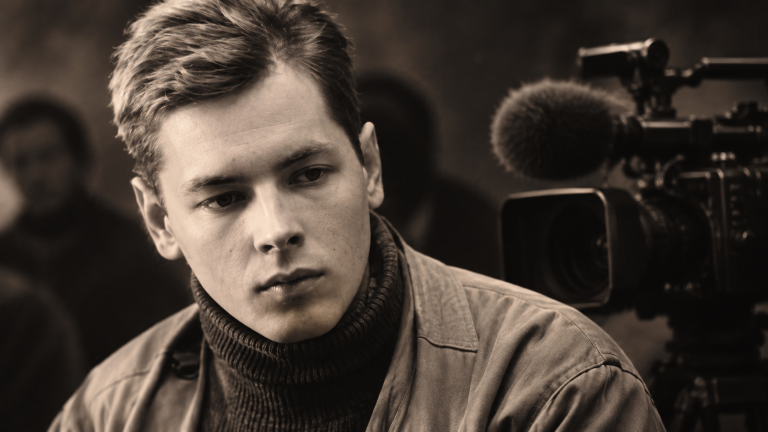
Chapter 1. A Young Cameraman in a Changing Belarus
Dzmitry Aliaksandravich Zavadski was born on 28 August 1972 in Minsk, in the Belarusian Soviet Socialist Republic. He grew up during the final decades of the Soviet era, when television was becoming one of the most influential ways of documenting public life and shaping people’s understanding of events.
He chose a career behind the camera. By 1994, he was working as a television cameraman and became part of the media team covering the activities of Alyaksandr Lukashenka, who had been elected president of Belarus that year.
Between 1994 and 1997, Zavadski worked as Lukashenka’s personal cameraman. His professional position gave him access to the highest levels of Belarusian political life and to the changing relationship between the state and the media.
But his career would soon take a different direction. Rather than remaining within the state-controlled television system, he joined the Russian television network ORT, where he worked with journalist Pavel Sheremet.
Chapter 2. A Camera Turned Towards the Authorities
In January 1997, Zavadski joined the Belarusian bureau of ORT. He and Pavel Sheremet worked on investigative reports that examined subjects the authorities found uncomfortable.
One of their important projects concerned the Belarusian-Lithuanian border. In 1997, they filmed a report demonstrating weaknesses in border security and the ease with which the border could be crossed.
The authorities responded by detaining both journalists. Zavadski and Sheremet were accused of illegally crossing the state border and received suspended sentences.
The incident demonstrated the risks faced by journalists who investigated matters involving state institutions and security services.
Zavadski continued working for ORT. His camera became a tool for recording events beyond the official version presented by Belarusian state media.
Chapter 3. Chechnya: Reporting from a War
From late 1999 until May 2000, Zavadski worked in Chechnya alongside Pavel Sheremet. They filmed a documentary project known as The Chechen Diary, covering the war and its consequences.
The assignment placed the cameraman in a dangerous environment, where journalists had to document military operations, political violence, and the experiences of people living through the conflict.
After returning from Chechnya, Zavadski reportedly began receiving threatening telephone calls from an unidentified person who insisted on meeting him.
His professional work had also attracted attention because of an interview he gave to the independent Minsk newspaper Belorusskaya Delovaya Gazeta. In it, he discussed Belarusians who had allegedly fought alongside Chechen forces against Russia.
The exact circumstances that led to his disappearance remain disputed. Journalists and human rights organisations later examined several possible motives, including retaliation for his reporting and the possibility that he possessed sensitive footage.
What is clear is that Zavadski continued working as a journalist despite the threats and the risks surrounding his profession.
Chapter 4. 7 July 2000: The Disappearance
On the morning of 7 July 2000, Zavadski drove to Minsk National Airport to meet Pavel Sheremet, who was arriving from Moscow.
He never appeared at the meeting.
His car was found locked in the airport parking area. Zavadski had disappeared without leaving any reliable information about his whereabouts.
Witnesses reportedly saw suspicious men near him, and his family and colleagues raised concerns that he had been abducted.
The investigation quickly became controversial. In March 2002, two former members of the Almaz special police unit, Valery Ignatovich and Maxim Malik, were sentenced to life imprisonment in a closed trial. They were convicted of abducting Zavadski, but the court did not establish what happened to him after the abduction. His body was never recovered.
The case was surrounded by serious allegations of a wider cover-up. Former Belarusian prosecution officials who fled abroad alleged that senior government figures had obstructed the investigation and that a state-linked death squad might have been involved.
In December 2003, a district court in Minsk officially declared Zavadski dead. The criminal investigation was later suspended, and the central questions about his fate and the possible involvement of people beyond those convicted remained unresolved.
Chapter 5. A Disappearance That Belarus Could Not Forget
Zavadski’s disappearance became one of the defining cases in the history of attacks on independent journalism in Belarus.
His family, colleagues, and the Belarusian Association of Journalists continued demanding answers. His wife, Sviatlana Zavadskaya, repeatedly challenged the authorities’ handling of the investigation and insisted that the truth about her husband’s fate had not been established.
The case also became part of a broader pattern of unresolved disappearances in Belarus during the late 1990s and early 2000s. Alongside the disappearances of opposition figures Yury Zakharenko, Viktar Hanchar, and Anatol Krasouski, it raised grave concerns about the use of political violence and the absence of accountability.
In December 2019, a former member of a Belarusian special rapid response unit gave an interview to Deutsche Welle alleging that members of the unit had abducted and killed Zavadski and other missing figures. Following the interview, a relative requested that the investigation be reopened. Belarusian authorities refused to resume it.
The allegation added to the body of evidence and testimony surrounding the case, but it did not produce an independent judicial determination of responsibility.
Dzmitry Zavadski’s body has never been found. His fate remains officially unresolved beyond the legal declaration of death.
His story is not only about one missing journalist. It is about the right to investigate, to report, to question those in power, and to expect the truth when a journalist disappears.
Historical Note
Dzmitry Aliaksandravich Zavadski (28 August 1972 – disappeared 7 July 2000) was a Belarusian television cameraman and journalist who worked for Belarusian television and the Russian network ORT. He was formerly the personal cameraman of Alyaksandr Lukashenka and later worked with journalist Pavel Sheremet, including on a documentary about the war in Chechnya.
He disappeared at Minsk National Airport on 7 July 2000. Two former members of the Almaz special police unit were convicted of his abduction in 2002. A Minsk court declared him legally dead in November 2003, but his body was never recovered.
Allegations of involvement by Belarusian security structures and senior officials have been raised by former investigators, journalists, human rights organisations, and a former special-unit member. These allegations have not been conclusively established through an independent judicial investigation.
This biography distinguishes confirmed events, court findings, and allegations. It does not present the identity of those who ordered or carried out his presumed murder as a legally established fact.