
Chapter 1. A Childhood in a Changing Country
Ihor Rafailovych Yukhnovskyi was born on 1 September 1925 in the village of Kniahynyn, in the Rivne region of what is now Ukraine. His childhood unfolded during a period of profound political change. The territory experienced successive changes of power, and the lives of ordinary families were shaped by competing political systems and the upheavals of the Second World War.
In 1944, Yukhnovskyi entered military service as a sapper in the Soviet Army. He served during the final years of the Second World War, taking part in the fighting to expel Nazi forces from Lviv and continuing his service as far as Austria.
After demobilisation, he returned to Lviv. Rather than pursue a military career, he chose science. He enrolled at the Physics Faculty of Ivan Franko Lviv State University, where he developed the mathematical and scientific foundations that would guide his life’s work.
He graduated in 1951 and continued in academic research. The decision to build his future in physics would eventually make him one of the most influential Ukrainian theoretical physicists of the twentieth century.
Chapter 2. Building a School of Theoretical Physics
Yukhnovskyi’s early academic career was closely connected with Lviv. After completing his university studies, he worked in teaching and research positions at several local institutions.
In 1954, he received his Candidate of Physical and Mathematical Sciences degree. In 1965, he defended his doctoral dissertation, establishing himself as a leading researcher in statistical physics.
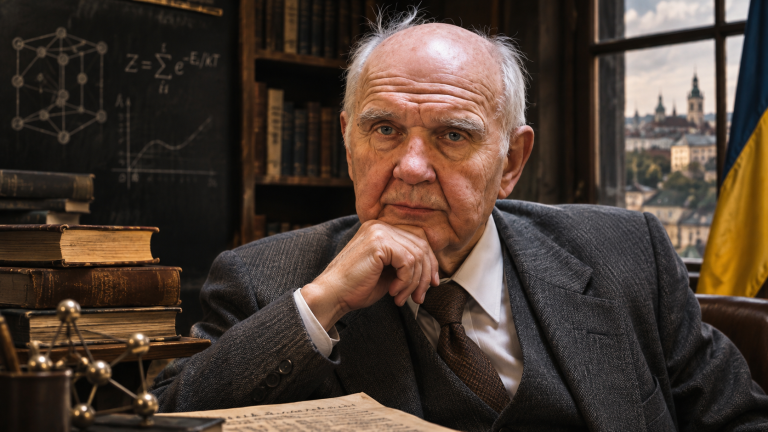
His scientific interests centred on the behaviour of systems consisting of many interacting particles. He developed theoretical methods for studying complex systems, including the method of collective variables and approaches to the statistical description of liquids, electrolytes, metals, alloys, and other condensed matter.
In 1969, he organised a department devoted to the statistical theory of condensed systems in Lviv. This work became the foundation for a distinctive Ukrainian research school in statistical physics.
In 1980, he headed the Lviv branch of the Institute of Theoretical Physics of the Academy of Sciences of the Ukrainian SSR. In 1990, he became director of the newly established Institute for Condensed Matter Physics of the National Academy of Sciences of Ukraine.
Yukhnovskyi was not simply an individual researcher. He created an environment in which other scientists could develop, collaborate, and establish new directions of investigation. Over the course of his career, he authored approximately 500 scientific publications.
Chapter 3. From Scientific Independence to Civic Responsibility
By the late 1980s, political change in the Soviet Union had opened new possibilities for public discussion and civic organisation in Ukraine.
Yukhnovskyi became increasingly involved in the movement for democratic reform and national self-determination. In 1987, he headed the Lviv branch of the Memorial society, an organisation devoted to investigating and preserving the memory of victims of Soviet political repression.
Together with other members, he supported research into the crimes of the totalitarian regime and the recovery of historical memory. The organisation also worked to restore places of remembrance, including the memorial complex dedicated to the Ukrainian Sich Riflemen at Lychakiv Cemetery in Lviv.
He supported initiatives defending the Ukrainian language and participated in the organisation of the People’s Movement of Ukraine for Perestroika, commonly known as Rukh.
For Yukhnovskyi, the preservation of historical truth was closely connected with the future of the country. A society could not build a democratic state, he believed, without understanding its past and acknowledging the people who had suffered under political repression.
His transition from scientific leadership to civic engagement did not mean abandoning his academic work. Instead, he increasingly understood public responsibility as another field in which knowledge, independence, and integrity mattered.
Chapter 4. A Parliamentarian in the Making of Independence
In March 1990, Yukhnovskyi was elected to the Verkhovna Rada of the Ukrainian SSR from a constituency in Lviv. He became one of the prominent figures of the democratic opposition and led the parliamentary group known as the People’s Council.
He was among the political leaders who advocated Ukraine’s state sovereignty and independence. He participated in the preparation of the Declaration of State Sovereignty of Ukraine, adopted on 16 July 1990, and supported the political process that led to the restoration of Ukrainian independence.
The Act of Declaration of Independence was adopted by parliament on 24 August 1991. Yukhnovskyi was also a strong supporter of the nationwide referendum held on 1 December 1991, in which voters confirmed the declaration.
From 1992 to 1993, he served as First Deputy Prime Minister of Ukraine. He continued his parliamentary work through four convocations, from 1990 to 2006, and contributed to debates on science, education, economic development, and the organisation of the new state.
His political career was rooted not in party leadership alone but in the conviction that Ukraine needed independent institutions and a democratic system capable of representing its citizens.
Chapter 5. Preserving the Memory of a Nation
After leaving parliament, Yukhnovskyi continued to work on questions of national memory and historical responsibility.
In 2006, he became acting head of the Ukrainian Institute of National Memory, serving until 2010. The institution was established to research, preserve, and communicate the history of Ukraine, including the experiences of people affected by totalitarian regimes.
His earlier involvement with Memorial gave this work a particular continuity. He had spent years supporting the recovery of names, places, and historical evidence connected with political repression. Now he was involved in developing a national institution dedicated to historical memory.
He also remained connected with the scientific community as an honorary director of the Institute for Condensed Matter Physics and an adviser to the Presidium of the National Academy of Sciences of Ukraine.
Yukhnovskyi received numerous honours, including the title Hero of Ukraine in 2005. Yet his legacy cannot be measured only through awards or official positions.
He belonged to a generation that experienced war, Soviet rule, the struggle for Ukrainian statehood, and the first decades of independence. His life connected the university, the laboratory, parliament, and institutions of historical memory.
Ihor Yukhnovskyi died in Lviv on 26 March 2024, aged 98. He was buried at Lychakiv Cemetery.
His legacy is that of a scientist who helped build a Ukrainian research school, a public figure who participated in the creation of an independent state, and an advocate of remembering those whose lives had been damaged or destroyed by totalitarian repression.
Historical Note
Ihor Rafailovych Yukhnovskyi (1 September 1925 – 26 March 2024) was a Ukrainian theoretical physicist, academician of the National Academy of Sciences of Ukraine, public figure, and politician. He established a major school of statistical physics in Lviv, served as a member of parliament from 1990 to 2006, and was First Deputy Prime Minister of Ukraine from 1992 to 1993.
He participated in the democratic movement of the late Soviet period, supported the establishment of Ukrainian state sovereignty and independence, and helped preserve the memory of victims of Soviet political repression through his work with the Memorial society and the Ukrainian Institute of National Memory.
This biography is based on institutional and historical sources. It does not portray Yukhnovskyi as a victim of political imprisonment: his documented public legacy is principally associated with scientific work, democratic political participation, state-building, and historical remembrance.