
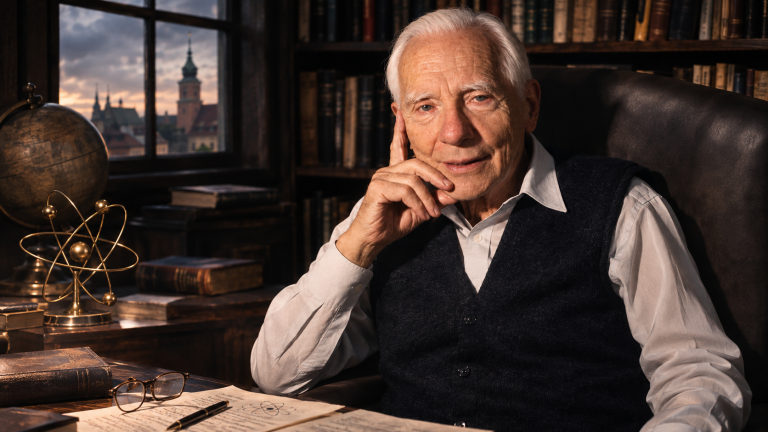
Chapter 1. A Warsaw Childhood and the Making of a Physicist
Joseph Rotblat was born Józef Rotblat on 4 November 1908 in Warsaw, then part of the Russian Empire. He grew up in a Jewish family whose comfortable circumstances were severely damaged by the First World War. The economic difficulties of the post-war years meant that his path into science would not be straightforward.
As a teenager, Rotblat worked as an electrician during the day while continuing his education in the evenings. He was determined to study physics, even though he had not followed the conventional route through secondary education.
His persistence brought him to the Free University of Poland in Warsaw, where he studied physics and received his master’s degree in 1932. He continued his research at the University of Warsaw, earning a doctorate in physics in 1938.
Rotblat became assistant director of the university’s Atomic Physics Institute. His research focused on nuclear physics, particularly the behaviour of neutrons and the possibility of nuclear reactions.
By the end of the 1930s, he had established himself as a promising young physicist. Yet the political situation in Europe was becoming increasingly dangerous. The rise of Nazi Germany and the threat of another war would soon transform the direction of his life and research.
Chapter 2. The War and the Atomic Project
In 1939, Rotblat travelled to Britain to work with the physicist James Chadwick at the University of Liverpool. He had accepted a research fellowship and expected to return to Poland after a period of scientific work.
The German invasion of Poland in September 1939 changed everything. Rotblat remained in Britain, while his wife, Tola, who had been unable to travel because of illness, stayed behind in occupied Poland. They were separated by the war and never reunited.
As the conflict developed, Rotblat became increasingly concerned that Nazi Germany might develop an atomic bomb. He believed that such a weapon in Hitler’s hands could have catastrophic consequences. This fear led him to take part in research connected with the British atomic programme.
In 1943, he joined the Allied effort that became known as the Manhattan Project, the secret American-led programme to develop the first atomic weapons. In early 1944, he travelled to Los Alamos, New Mexico, where he worked with other scientists on nuclear research.
Rotblat’s participation was driven by the belief that the Allies might need to prevent Nazi Germany from gaining a decisive military advantage. He did not regard the bomb as an ordinary scientific achievement. He understood its destructive potential and was deeply troubled by the consequences of its development.
Chapter 3. The Decision to Leave
During 1944, Rotblat became convinced that Germany was no longer capable of developing an atomic bomb before the end of the war.
The original reason that had persuaded him to participate in the project — preventing Hitler from acquiring such a weapon first — therefore no longer seemed valid.
He was also disturbed by the possibility that the atomic bomb might be developed for purposes beyond defeating Nazi Germany. He feared that nuclear weapons could become instruments of international intimidation and lead to a dangerous arms race.
Rotblat requested permission to leave the Manhattan Project and return to Britain. His departure was approved, and he left Los Alamos in December 1944.
His decision was exceptional. He became widely recognised as the only scientist to leave the Manhattan Project on grounds of conscience.
His departure also brought suspicion from military security officials. He was accused of possible espionage, an allegation for which no credible evidence was established. For years, he faced restrictions on returning to the United States.
The war brought him a devastating personal loss as well. In 1945, he learned that his wife, Tola, had been murdered by the Nazis in occupied Poland, reportedly at the Belzec extermination camp. The separation that had begun when he left Warsaw had ended in tragedy.
Rotblat had lost his homeland, his wife, and the possibility of returning to the life he had known before the war. Yet he did not abandon science. Instead, he began to reconsider what scientific knowledge should be used for.
Chapter 4. Science in the Service of Humanity
After returning to Britain, Rotblat continued his academic career. He worked at the University of Liverpool and later turned increasingly towards medical physics, studying the effects of radiation on living organisms and its possible applications in medicine.
In 1950, he became Professor of Physics at St Bartholomew’s Hospital Medical College in London. He held this position until 1976.
His concern about nuclear weapons, however, became the defining public commitment of his life.
In 1955, Rotblat became one of the signatories of the Russell–Einstein Manifesto, initiated by Bertrand Russell and supported by Albert Einstein shortly before his death. The manifesto warned humanity about the existential dangers of nuclear weapons and called on scientists to confront the consequences of modern warfare.
It urged governments and citizens to recognise that humanity’s survival had become a shared responsibility.
Rotblat helped turn this appeal into an international movement. In 1957, he was among the organisers of the first Pugwash Conference on Science and World Affairs, held in Pugwash, Nova Scotia, Canada.
The conferences brought together scientists from countries divided by the Cold War. Their purpose was to create opportunities for dialogue, examine the dangers of nuclear weapons, and seek ways to reduce international tensions.
Rotblat believed that scientists had a responsibility extending beyond their laboratories. Scientific discovery, he argued, could not be separated from the moral consequences of its use.
Chapter 5. A Nobel Prize and a Lifelong Appeal
Over the following decades, Rotblat became one of the most respected international voices for nuclear disarmament.
He served as Secretary General of the Pugwash Conferences and later as their President. He helped sustain communication among scientists from countries whose governments were often in direct political and military confrontation.
His work was not limited to opposing nuclear weapons. He advocated the peaceful use of scientific knowledge, public education, international cooperation, and the development of a global culture of responsibility.
In 1995, fifty years after the atomic bombings of Hiroshima and Nagasaki, Joseph Rotblat and the Pugwash Conferences jointly received the Nobel Peace Prize.
The Nobel Committee recognised their efforts to diminish the role of nuclear arms in international politics and, ultimately, to eliminate them.
In his Nobel lecture, titled Remember Your Humanity, Rotblat returned to a principle that had guided his decision to leave the Manhattan Project: scientific progress must never be allowed to destroy the humanity it is meant to serve.
He continued to speak and write about nuclear dangers well into old age. He died in London on 31 August 2005, aged 96.
Joseph Rotblat’s life demonstrates that scientific responsibility is not measured only by discoveries or professional achievements. It is also measured by the decisions a person makes when knowledge gives them the power to influence the fate of others.
He had entered the atomic project because he feared what would happen if Nazi Germany built the bomb first. He left when that justification disappeared, and spent the rest of his life working to ensure that humanity would never again accept nuclear destruction as inevitable.
Historical Note
Joseph Rotblat (4 November 1908 – 31 August 2005) was a Polish-born, British physicist and campaigner for nuclear disarmament. Born in Warsaw, he studied at the Free University of Poland and the University of Warsaw before moving to Britain in 1939.
He joined the Manhattan Project in 1944 but left in December of that year after concluding that Nazi Germany was no longer developing an atomic bomb and that the original justification for his participation had disappeared. His wife, Tola, who had remained in occupied Poland, was murdered during the Holocaust.
After the war, Rotblat devoted much of his life to medical physics, nuclear disarmament, and international scientific cooperation. He was a signatory of the 1955 Russell–Einstein Manifesto and helped organise the first Pugwash Conference in 1957. In 1995, he and the Pugwash Conferences jointly received the Nobel Peace Prize.
This biography is based on Nobel Prize records, the Pugwash Conferences’ historical materials, archival records, and research on the Manhattan Project.