
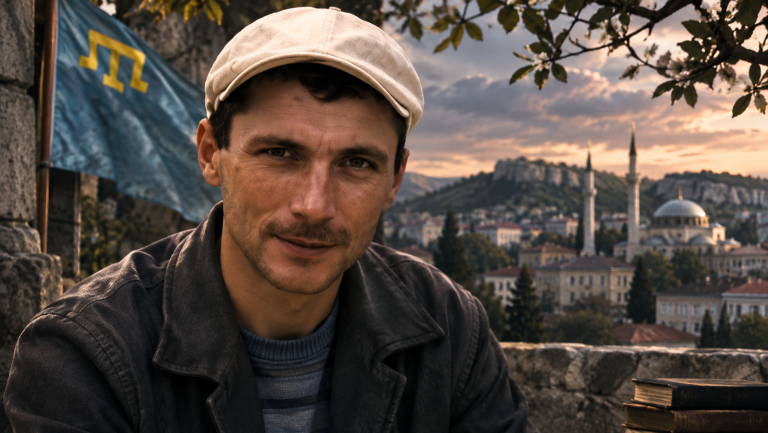
Chapter 1. A Family That Remembered Crimea
Reshat Midatovych Ametov was born on 24 January 1975 into a Crimean Tatar family. Sources differ on his exact birthplace: some identify Simferopol, while others place his birth in Uzbekistan, where his family had been living after the deportation of the Crimean Tatars in 1944.
His family history carried the memory of displacement. His grandfather, Kadir Ametov, had been involved in an underground intelligence network in Crimea during the Second World War. In May 1944, despite his wartime service, he and his family were forcibly deported to the Samarkand region of Uzbekistan along with the Crimean Tatar population.
Reshat’s father, Midat Ametov, was active in the Crimean Tatar national movement in Uzbekistan. He died when Reshat was young, and his mother raised Reshat, his brother Refat, and his sister Aishe.
The family’s eventual return to Crimea was part of the wider struggle of Crimean Tatars to come back to their homeland after decades of forced exile.
For Reshat, being Crimean Tatar was not simply a matter of ancestry. It was connected to the right to live in one’s homeland, preserve one’s language, and be recognised as part of its society.
Chapter 2. An Ordinary Life and a Sense of Justice
After returning to Crimea, Ametov studied at the National Academy of Environmental and Resort Construction in Simferopol, qualifying as a civil engineer. He worked in construction and also earned money as a driver.
He married and became the father of three children. People who knew him remembered him as a devoted husband and father who took an active part in raising his children. He valued education, music, and reading. His family listened to classical composers, including Chopin, Bach, and Mozart.
Ametov was also interested in the ideas of Mahatma Gandhi and nonviolent resistance. He believed that people could defend their rights through peaceful protest and civic action.
His commitment to justice became visible in local disputes. In 2012–2013, he challenged decisions by local authorities that affected his household. When his home was disconnected from electricity in a dispute involving a gardening cooperative, he went on hunger strike and organised a protest in Simferopol. His demands were eventually met.
He also supported the use of the Crimean Tatar language in public life. In one case, he helped secure a trilingual sign for the Perovsk village council, including Crimean Tatar.
These actions reflected a consistent conviction: rights should not depend on a person’s ethnicity, political connections, or willingness to remain silent.
Chapter 3. A Man Who Refused to Remain Silent
In late February 2014, Russian forces began taking control of key government buildings and strategic locations in Crimea. The peninsula entered a period of rapid military and political upheaval.
Ametov followed the events closely and supported the Revolution of Dignity in Ukraine. On 28 February, after Russian forces had seized the building of the Crimean Council of Ministers, he announced on social media that he intended to hold a silent protest.
He also planned to volunteer for military service.
On the morning of 3 March 2014, Ametov left his home in Simferopol. He went to the central square near the Council of Ministers of the Autonomous Republic of Crimea.
There, he stood alone with a protest against the occupation.
He was not carrying a weapon. He was not leading an armed group. His protest was a peaceful public act of opposition to the seizure of his homeland.
The square was occupied by Russian military personnel and members of the so-called Crimean Self-Defence formations. Ametov was approached by several men, forcibly taken away, and put into a vehicle.
The abduction was recorded on video. He was never seen alive again.
Chapter 4. The Crime That Could Not Be Silenced
On 15 March 2014, Ametov’s body was found near the village of Zemlyanichne in the Bilohirsk district of Crimea.
He had suffered severe torture. His body bore numerous injuries, and his death was officially treated as a violent killing. The discovery shocked the Crimean Tatar community and those who had been following the occupation of the peninsula.
Ametov was buried on 18 March at the Abdal Muslim cemetery in Simferopol. Thousands of people came to pay their respects.
His murder became one of the earliest documented cases of the violent persecution of a pro-Ukrainian activist during the Russian occupation of Crimea.
Ukrainian investigators later identified three men suspected of involvement in his abduction: two members of the so-called Crimean Self-Defence and a former Russian military serviceman. Suspicions were formally announced in 2019, and the case was subsequently sent to court.
However, the perpetrators have not been brought to justice. The occupation of Crimea has severely restricted the ability of Ukrainian investigators to access the crime scene and pursue the case.
In its reporting on Crimea, the United Nations Human Rights Monitoring Mission documented Ametov’s abduction, torture, and extrajudicial killing.
His case remains a stark example of the danger faced by civilians who publicly opposed the occupation.
Chapter 5. The Meaning of One Silent Protest
Reshat Ametov was posthumously awarded the distinction People’s Hero of Ukraine in 2015. On 17 May 2017, he was awarded the title Hero of Ukraine and the Order of the Golden Star for his civic courage, heroism, and self-sacrifice in defending Ukraine’s sovereignty and territorial integrity.
His name has become part of the history of Crimean resistance.
Yet his story is not only about the final act of standing alone in a public square. It is also about a family shaped by deportation, a father who cared for his children, a man who defended his rights in everyday disputes, and a citizen who believed that peaceful protest was a meaningful form of resistance.
Ametov did not command an army or hold public office. On 3 March 2014, he simply chose not to pretend that the occupation of his homeland was acceptable.
His solitary protest became a symbol of the courage of ordinary people confronting military force and political intimidation.
Reshat Ametov’s story reminds us that resistance does not always begin with weapons or crowds. Sometimes it begins with one person standing in a public square, refusing to surrender the right to speak.
Historical Note
Reshat Midatovych Ametov (24 January 1975 – March 2014) was a Crimean Tatar civic activist and the first widely recognised victim of Russia’s armed aggression against Ukraine in Crimea.
On 3 March 2014, he staged a solitary peaceful protest against the Russian occupation in central Simferopol. Members of the so-called Crimean Self-Defence abducted him in circumstances recorded on video. His tortured body was discovered on 15 March near Zemlyanichne, in Crimea.
Ukrainian authorities identified three suspects in connection with his abduction and murder. The case has not resulted in a final conviction, and the perpetrators remain unpunished. In 2017, Ametov was posthumously awarded the title Hero of Ukraine.
This biography distinguishes established events from unresolved questions concerning individual criminal responsibility. The circumstances of his abduction, torture, and death are documented, while the full chain of responsibility has not been determined by a final court judgment.