A young man with an unfinished dream
In 1940, Juozas Lukša was a young student with a future ahead of him. He had graduated from the Aušra Gymnasium in Kaunas, Lithuania, and begun studying architecture at Vytautas Magnus University.
He could have imagined a life filled with drawings, buildings, and the ordinary challenges of becoming an adult. But the world around him was changing faster than any young person could prepare for.
In June 1940, the Soviet Union occupied Lithuania. The country’s independence was taken away, and political repression began to reshape everyday life. For many Lithuanians, the occupation brought fear, uncertainty, arrests, and the question of how to respond when the future of their country was no longer in their own hands.
Lukša became involved in resistance activity. In 1941, he was arrested and imprisoned for his anti-Soviet activities. When the war between Nazi Germany and the Soviet Union began that June, he escaped from prison.
Between two occupations
Lithuania’s history during the Second World War was marked by successive occupations. After the Soviet occupation came Nazi German rule. The Holocaust destroyed Lithuania’s Jewish communities.
During the German occupation, Lukša continued his studies and became involved in underground political activity. The surviving accounts of his early activities and affiliations have been examined by historians, and aspects of his biography remain subjects of historical discussion.
In 1944, the Soviet Union returned to Lithuania. For Lukša and many others who opposed Soviet rule, this meant another period of occupation and another decision about how to live.
He joined the armed resistance.
Into the forests
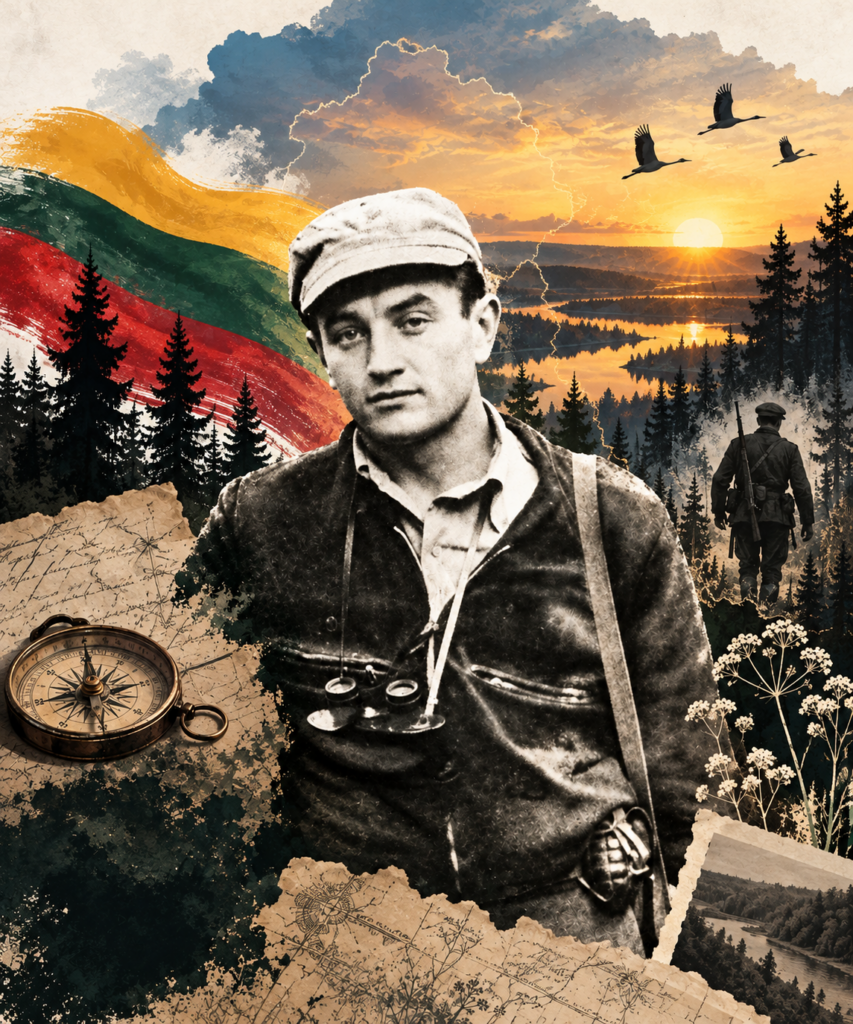
After the Soviet return, Lithuanian partisans fought a guerrilla war against Soviet rule. Many operated in forests, using hidden bunkers and relying on networks of people who provided information, food, shelter, and messages.
The forest was not simply a place to hide. It became a world of its own, with its own dangers, responsibilities, and fragile connections to life beyond the trees.
Lukša took on increasingly important roles in the resistance. He worked with the Geležinis Vilkas unit of the Tauro partisan district and became involved in underground publishing, including the resistance newspaper Laisvės Žvalgas.
A newspaper might seem like a small thing beside an armed struggle. But under censorship and repression, words could become a form of resistance. They could preserve information, connect isolated people, and remind readers that the official version of reality was not the only one.
The partisans faced military operations, arrests, betrayal, and the constant danger of losing the people they trusted. Their struggle also placed civilians at risk. Behind every name remembered in a history book were families and communities living with uncertainty.
A mission beyond the Iron Curtain
By the late 1940s, the resistance needed more than fighters in the forests. It needed contact with the outside world.
In 1947, Lukša left Lithuania on a mission to establish connections with Lithuanian representatives and communities abroad. He crossed the Soviet-controlled border and eventually reached the West. He later returned to the region on another mission before travelling back to Western Europe.
In 1949, the Lithuanian Freedom Fight Movement appointed him as its representative abroad.
His mission was to communicate what was happening in Lithuania, build relationships with Lithuanian communities in exile, and seek support for the resistance. In a Europe increasingly divided by the Cold War, this was dangerous work. The Soviet authorities wanted to isolate the resistance and prevent information about it from reaching international audiences.
Lukša was no longer simply a young man who had taken up arms. He had become a messenger between two worlds: the Lithuania in which people continued to resist Soviet rule and the Western communities that were trying to understand what was happening behind the Iron Curtain.
He also wrote about the partisan struggle. Under the name Daumantas, he became known for his memoir Partizanai (Forest Brothers in English-language publication).
His writing helped preserve a record of the resistance from the perspective of someone who had experienced it.
The decision to return
In 1950, Lukša made a decision that would shape the final year of his life.
He returned to Soviet-occupied Lithuania by parachute and resumed his work with the underground resistance. He was appointed to a senior intelligence position within its military leadership.
By then, he had experienced life beyond the forests. He had seen the Lithuanian diaspora and understood the importance of international attention. He could have remained abroad, away from the immediate dangers facing the partisans.
Instead, he went back.
We cannot know every thought behind that decision. It would be too easy to describe it as a simple, unquestioning act of heroism. The resistance was divided, its resources were limited, and Soviet security forces were relentless. Returning meant accepting extraordinary risks, not knowing whether the mission could succeed or whether he would ever see freedom in Lithuania.
What we do know is that he returned to a country where the struggle was still continuing.
The last journey
On 4 September 1951, Juozas Lukša-Daumantas was killed near Pabartupis, south of Kaunas. Historical accounts state that his location had been betrayed.
He was thirty years old.
The exact location of his remains has never been established with certainty. His death did not immediately end the partisan struggle, which continued in Lithuania until the early 1950s.
The forest that had sheltered so many resistance fighters became a place of memory: a reminder of people who lived outside ordinary society because the political order around them had left them few acceptable choices.
Lukša’s life ended, but his memoirs and the records of his activities survived. His name became part of Lithuania’s public memory of resistance to Soviet rule.
What remains after a life of resistance?
Juozas Lukša-Daumantas lived through a period when Lithuania was occupied first by the Soviet Union, then by Nazi Germany, and then again by the Soviet Union. His life was shaped by the consequences of those occupations and by his decision to take part in the resistance.
Lukša’s journey across the Iron Curtain and back is a reminder of how far a person may travel when the future of home seems uncertain. But his story also invites a quieter question.
What does it mean to belong to a country when that country is no longer free? Is belonging a place, a language, a memory, or a responsibility carried even when home becomes dangerous?
There is no single answer. Each generation must find its own way of understanding the people who came before it.
Yet their stories deserve to be preserved—not as flawless legends, but as part of the difficult human history through which nations remember who they were, what they endured, and what they still need to understand.
Because history is not only about the people who won or lost. It is also about the people whose choices, words, and memories survived them.
Historical note
This story is based on published biographical material from the Vytautas the Great War Museum and the Prienai Regional Museum, alongside academic research into Lukša-Daumantas’s early biography. His activities and affiliations during 1940–1941 have been the subject of historical study and public debate. The history of Lithuania during the Nazi occupation, including the Holocaust and the participation of local collaborators in mass murder, must be acknowledged as an essential part of the period’s history.
Further reading
- Vytautas the Great War Museum — Juozas Lukša: Biography
- Prienai Regional Museum — Juozas Lukša-Daumantas
- Alfredas Rukšėnas — Biography Pages of Juozas Albinas Lukša-Daumantas, 1940–1941, journal Genocidas ir rezistencija, 2020.
- Juozas Daumantas — Partizanai, published in English as Forest Brothers: The Account of an Anti-Soviet Lithuanian Freedom Fighter, 1944–1948.