Chapter 1. A Village Boy with a Poet’s Eyes
Todar Todaravich Klyashtorny was born on March 11, 1903, in Porechcha, a village in the Lepel district of what is now Belarus. He came from a peasant family, and the landscapes of rural Belarus formed the world of his childhood.
In a village, the seasons are never abstract ideas. Spring arrives in wet fields and swollen streams. Summer brings the smell of grass and the hum of insects. Autumn turns the leaves gold and copper, while winter makes familiar roads disappear beneath snow.
For a future poet, such a world offered an endless source of images and feelings. The ordinary details of life could carry extraordinary meaning: a tree bending in the wind, a lonely road, a distant light in a window.
Klyashtorny grew up during a period of enormous political and social change. Belarusian cultural life was developing, and a new generation of writers was searching for ways to express the experiences, hopes, and uncertainties of its people.
His path would eventually lead away from the village and into the literary circles of Minsk. But the world he had known in childhood remained an important part of the landscape from which his poetry emerged.
Chapter 2. The Road to Words
After serving in the army, Klyashtorny studied at a workers’ faculty in Orsha. He later continued his education at Belarusian State University in Minsk, graduating in 1931 from its literary and linguistic department within the pedagogical faculty.
The university opened a new world before him. It brought him into contact with books, ideas, fellow writers, and the growing cultural life of the Belarusian capital.
Klyashtorny began publishing his poetry in 1925 in the magazine Orshansky Maladnyak. His first poetry collection, Klyanovyya Zavei — commonly translated as Maple Blizzards — appeared in 1927.
Further collections followed: Svetatseni (Light and Shadows) in 1928 and Vetrazі (Sails) in 1929. His writing revealed a poet interested not only in the world around him but also in the shifting landscape of human feeling.
He became associated with literary groups including Maladnyak and Uzvysha, which brought together writers participating in the development of modern Belarusian literature.
For Klyashtorny, poetry was more than a private activity. It was a way to participate in a culture that was finding new forms of expression and reaching new readers.
Chapter 3. The Poet of Changing Light
The literary world of the 1920s was full of experiments. Writers debated what literature should become, how it should speak to ordinary people, and how it could remain connected to the Belarusian language while responding to a rapidly changing society.
Klyashtorny’s poetry occupied its own distinctive space within this world. His work was associated with lyrical reflection, romantic feeling, and a sensitivity to atmosphere. His poems could turn to nature and the inner life at a time when public discourse increasingly demanded a different kind of literary voice.
In 1930, he published the poem Pali Zagamanili, often rendered in English as The Fields Began to Speak. In 1934 came Pra Shtorm na Shturm, a title commonly translated as Through the Storm to the Assault.
He also wrote for children. His illustrated book Pra Zaitsa, Vauka i Miedzvedzia — About the Hare, the Wolf, and the Bear — appeared in 1935, showing another side of his literary work.
Alongside his own writing, Klyashtorny translated works by poets including Vladimir Mayakovsky and other Soviet authors into Belarusian. Translation allowed ideas and artistic voices to travel between languages, enriching the possibilities of Belarusian literature.
Yet the space available for independent literary expression was narrowing. Writers increasingly faced ideological demands, and work that did not fit official expectations could attract criticism and suspicion.
The poet’s task became more difficult: to continue listening to the subtle movements of human experience while the world around him demanded that every voice follow a single direction.
Chapter 4. When the Words Were Silenced
By the middle of the 1930s, political repression had spread through Soviet society. Intellectuals, teachers, artists, and writers were increasingly targeted by the state.
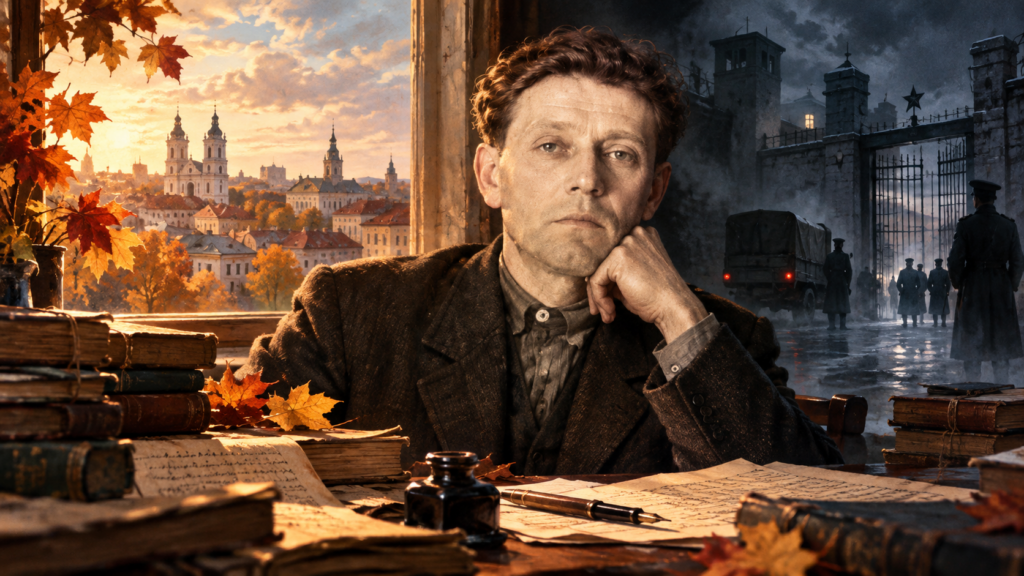
Todar Klyashtorny was arrested in Minsk on November 3, 1936. He was accused of belonging to an alleged anti-Soviet organization. Such accusations were used widely during Stalinist repression, often turning ordinary cultural and professional lives into grounds for persecution.
His literary career came to an abrupt end.
On October 29, 1937, an extrajudicial body sentenced him to death. He was executed in Minsk on October 30, at the age of thirty-four.
The violence did not stop with the poet. His wife, Yanina Hermanovich, was also arrested and sentenced later in 1937. Their family was left to face the consequences of a system that punished not only individuals but also those connected to them.
Klyashtorny’s death formed part of a wider tragedy for Belarusian culture. Writers and cultural figures were imprisoned, executed, or forced into silence. Manuscripts and books could disappear, and families were often left without clear explanations of what had happened.
The loss was not merely personal. Each silenced writer represented a distinct way of seeing the world, a voice that could no longer develop or speak to future generations.
Chapter 5. The Light That Returned
For years, Klyashtorny’s life and work existed beneath the shadow of political repression. The circumstances of his death interrupted the natural relationship between a writer and his readers: poems that might have continued to grow into new books were left behind, while the person who created them was removed from the literary world.
In 1957, Klyashtorny was rehabilitated. The official recognition came too late to restore his life, but it helped challenge the accusations that had led to his execution.
His poetry gradually returned to public memory. Collections of his work were published after his death, including Zalatoe Viasmo in 1960, allowing readers to encounter more of the writing that had survived.
His legacy also continued through his family. His daughter Tadziana became a children’s writer, carrying literature into another generation.
Today, Todar Klyashtorny is remembered as part of the generation of Belarusian writers whose lives were cut short during the Great Terror. His story is not only about repression and loss. It is also about the endurance of language, the value of artistic freedom, and the responsibility to remember those whose voices were forcibly silenced.
A poem can survive the circumstances that destroyed its author. A book can travel further than the person who wrote it. And a language can preserve traces of lives that history once tried to erase.
The wind still moves through the maples. The pages remain. The poet’s name can be spoken again.