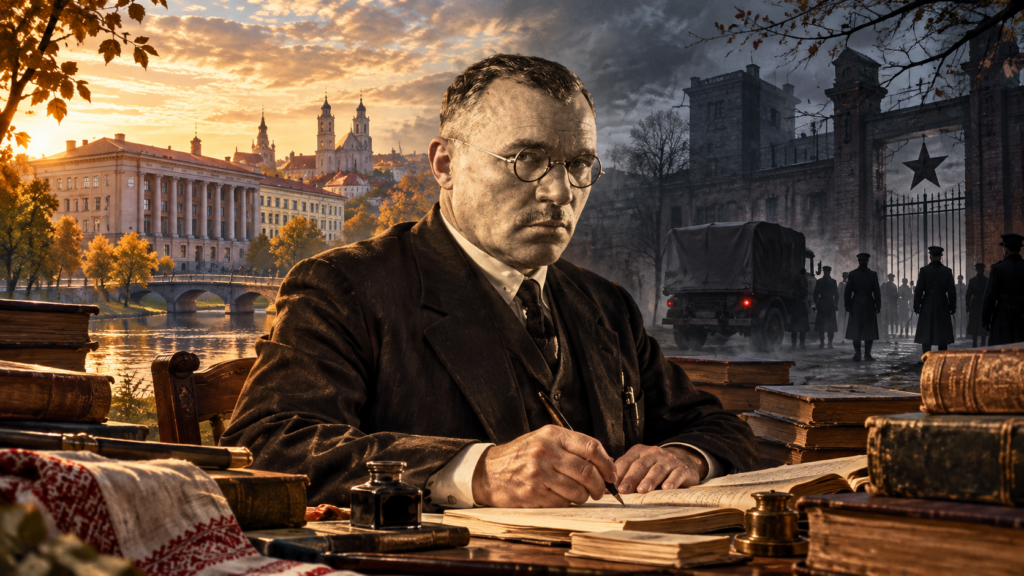
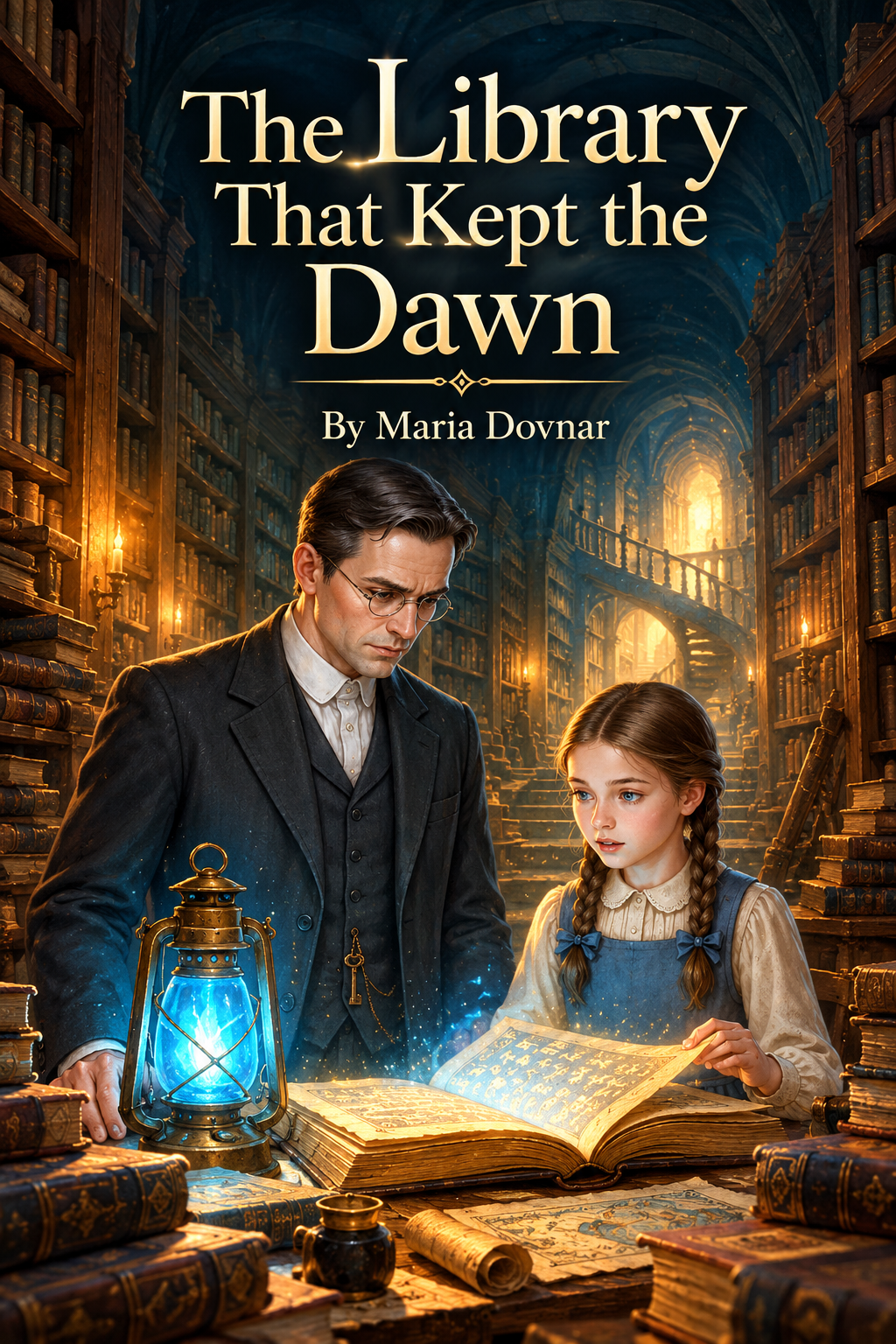
Chapter 1. The Boy Who Collected Words
Long ago, in the Belarusian town of Zaslawye, there lived a boy named Yanka who collected words the way other children collected marbles.
He kept them in a small wooden box beneath his bed.
There were words he heard from his grandmother while she baked bread, words his teacher wrote on the blackboard, and words spoken by old people sitting outside their houses in the evening.
Yanka loved the Belarusian language most of all. To him, every word carried a little piece of the land: the smell of rye fields, the sound of rain on a wooden roof, the warmth of a family gathered around a table.
One winter evening, his grandmother gave him a tiny brass key.
“This opens a door you cannot see yet,” she told him.
Yanka turned the key over in his hand. “Where is the door?”
“When you find a place where people are afraid to learn, you will know.”
Years passed. Yanka became a teacher, and the wooden box grew too small for all the words he had gathered. He filled notebooks instead, writing down stories, songs, and the names of things people feared might one day be forgotten.
Then, one rainy afternoon, a letter arrived from the city.
A school needed someone who believed that every child deserved to learn.
Yanka packed his notebooks, placed the brass key in his pocket, and set off for Minsk.
He did not know that the key would lead him to a library unlike any other.
Chapter 2. The Library Beneath the University
Minsk was full of noise: carts rattling over the streets, tram bells ringing, students hurrying between buildings, and teachers carrying stacks of books beneath their arms.
Yanka began teaching at a school where the windows rattled in the wind and the blackboard was so old that no amount of washing could make it completely clean.
Yet the children came eagerly.
One morning, a girl named Hanna stayed behind after class.
“Teacher,” she asked, “why do some people say our language belongs only in our homes?”
Yanka thought for a moment.
“Does a bird belong only in its nest?” he asked.
“No,” Hanna replied. “It belongs in the sky.”
“And a language,” said Yanka, “belongs wherever people need to speak, learn, imagine, and understand one another.”
That evening, he heard a faint tapping beneath the floorboards of the school library.
Tap. Tap. Tap.
He moved a cabinet and discovered a narrow wooden door. Its lock was shaped like a tiny sun.
Yanka took out the brass key.
It fitted perfectly.
Behind the door, a staircase descended into a vast underground library. Shelves stretched farther than he could see. Thousands of books glimmered softly in the darkness, but their pages were blank.
At the centre stood an old woman in a grey cloak.
“Welcome,” she said. “This is the Library of Unfinished Tomorrows.”
“Why are all the books empty?” Yanka asked.
“Because every book here is waiting for someone brave enough to write what must not be forgotten.”
She handed him a lantern.
Its flame was small, blue, and almost invisible.
“Protect this light,” she warned him. “It burns with the courage of people who continue learning, even when the world tells them to stop.”
Chapter 3. The Rector and the Shadow
Years passed, and Yanka became a respected teacher. Eventually, he was invited to help lead a great university in Minsk.
The university was a city of its own, filled with lecture rooms, laboratories, libraries, and young people who dreamed of becoming scientists, writers, doctors, and teachers.
Yanka believed that the university should open doors for everyone.
He wanted students to study their country's history, explore its culture, and learn to ask difficult questions. He wanted teachers to help young people think for themselves.
At night, he returned to the hidden library.
Each day, another blank book gained a few lines. One recorded a grandmother's lullaby. Another held the words of a village storyteller. A third contained a child's first poem in Belarusian.
But one autumn, a dark mist began creeping through the underground rooms.
Wherever it passed, the books grew pale.
The old woman appeared beside Yanka's lantern.
“The Shadow of Silence is growing,” she said. “It feeds on fear. It makes people hide their words, distrust their neighbours, and forget that knowledge belongs to everyone.”
“How can I stop it?” Yanka asked.
“You cannot defeat it with a sword. You must keep the light alive in others.”
So Yanka taught his students to help one another. He encouraged them to write down the stories of their families, to preserve old songs, and to ask questions even when the answers were difficult.
Every time someone shared a forgotten word, the lantern brightened.
For a while, the Shadow retreated.
Then one morning, Yanka noticed that people in the university corridors had begun whispering. Some books disappeared from the shelves. Teachers stopped visiting one another. Students looked over their shoulders before speaking.
The Shadow had found a new way to grow.
It no longer needed darkness.
It had learned to disguise itself as fear.
Chapter 4. The Night of the Locked Doors
Winter arrived early that year.
One night, Yanka heard heavy footsteps outside his home. A knock sounded at the door, sharp and sudden.
He was taken away, and the brass key slipped from his pocket onto the frozen ground.
No one knew where he had gone.
In the underground library, the blue lantern began to flicker. The Shadow poured between the shelves, turning bright pages grey and covering the floor with frost.
Hanna, now a young teacher herself, found the hidden staircase.
She picked up the fallen key and descended into the library.
The old woman was waiting beside the dying lantern.
“Yanka is gone,” Hanna whispered. “How can we save the books without him?”
The old woman pointed to the shelves.
“Look carefully.”
Hanna saw that the books were not entirely empty. Tiny words still glowed beneath the grey dust.
She opened one book and read a story about a farmer who had planted an orchard after a terrible storm. In another, she found a song her grandmother used to sing. In a third, she discovered the words of children who had promised to teach one another.
Hanna called the other students.
They came quietly, carrying notebooks, pencils, and memories.
One wrote down a folk song. Another recorded a story told by his grandfather. A third copied a poem before its fading letters vanished.
The Shadow rushed towards them.
But whenever a student spoke a word aloud, the lantern grew brighter.
The library filled with voices.
The Shadow shrank away from the shelves, twisting and trembling like smoke in the wind. It could erase a page, but it could not make every person forget the same story at once.
At last, the blue flame rose high above the lantern.
The Shadow fled through a crack in the stone wall.
The books remained imperfect. Some pages were lost, and some stories could never be recovered.
But the library was no longer silent.
Chapter 5. The Dawn That Passed from Hand to Hand
Years went by.
Hanna became a teacher who carried a notebook wherever she travelled. Her students collected words from grandparents, neighbours, poets, farmers, and travellers.
They wrote them down carefully, knowing that a language lived not only in dictionaries but in the people who used it.
The underground library changed, too.
Its books no longer waited for a single keeper. Each new student who entered brought a story, a question, or a memory. Each visitor helped the blue lantern shine.
One spring morning, Hanna returned to the staircase and found a new book on the central table.
Its cover bore no title.
Inside, the first page contained only one sentence:
*The light belongs to those who pass it on.*
Hanna smiled.
She understood that the library had never truly belonged to Yanka, to the old woman, or even to the people who had built it. It belonged to everyone who believed that learning was worth protecting.
As for Yanka, the world beyond the library remembered him only imperfectly. Some people forgot his name. Others remembered the teacher who had worked for a university and for the future of Belarusian education.
But in the Library of Unfinished Tomorrows, his lantern remained.
Its blue flame shone through the darkest nights, waiting for another child to discover the power of a word.
And whenever someone opened a book, learned a new idea, or spoke a language they had been told to hide, the lantern burned a little brighter.
For dawn, the old woman used to say, did not always arrive from the sky.
Sometimes it began in a classroom.
Sometimes it began in a book.
And sometimes it began with one brave person who refused to let the light go out.