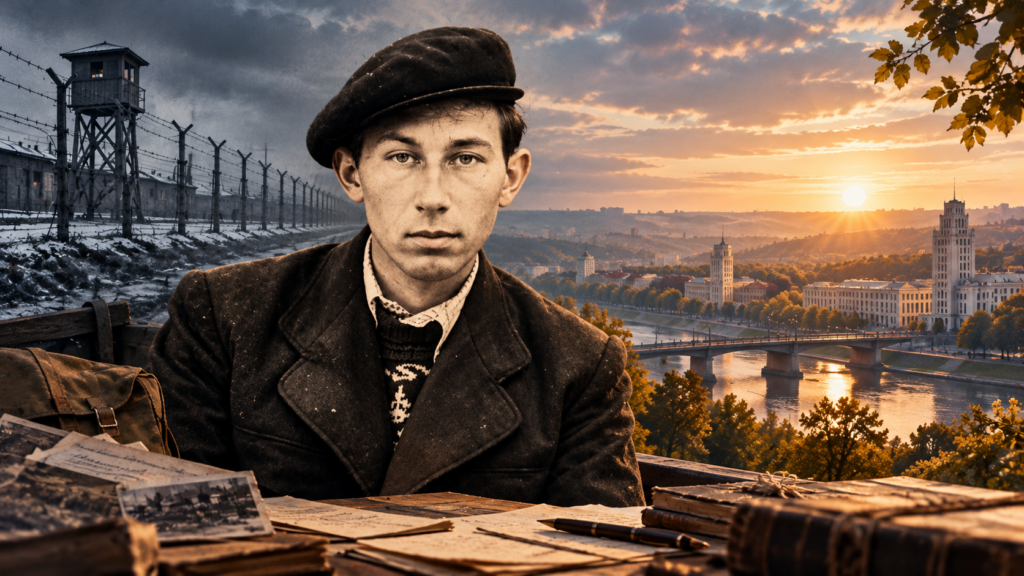
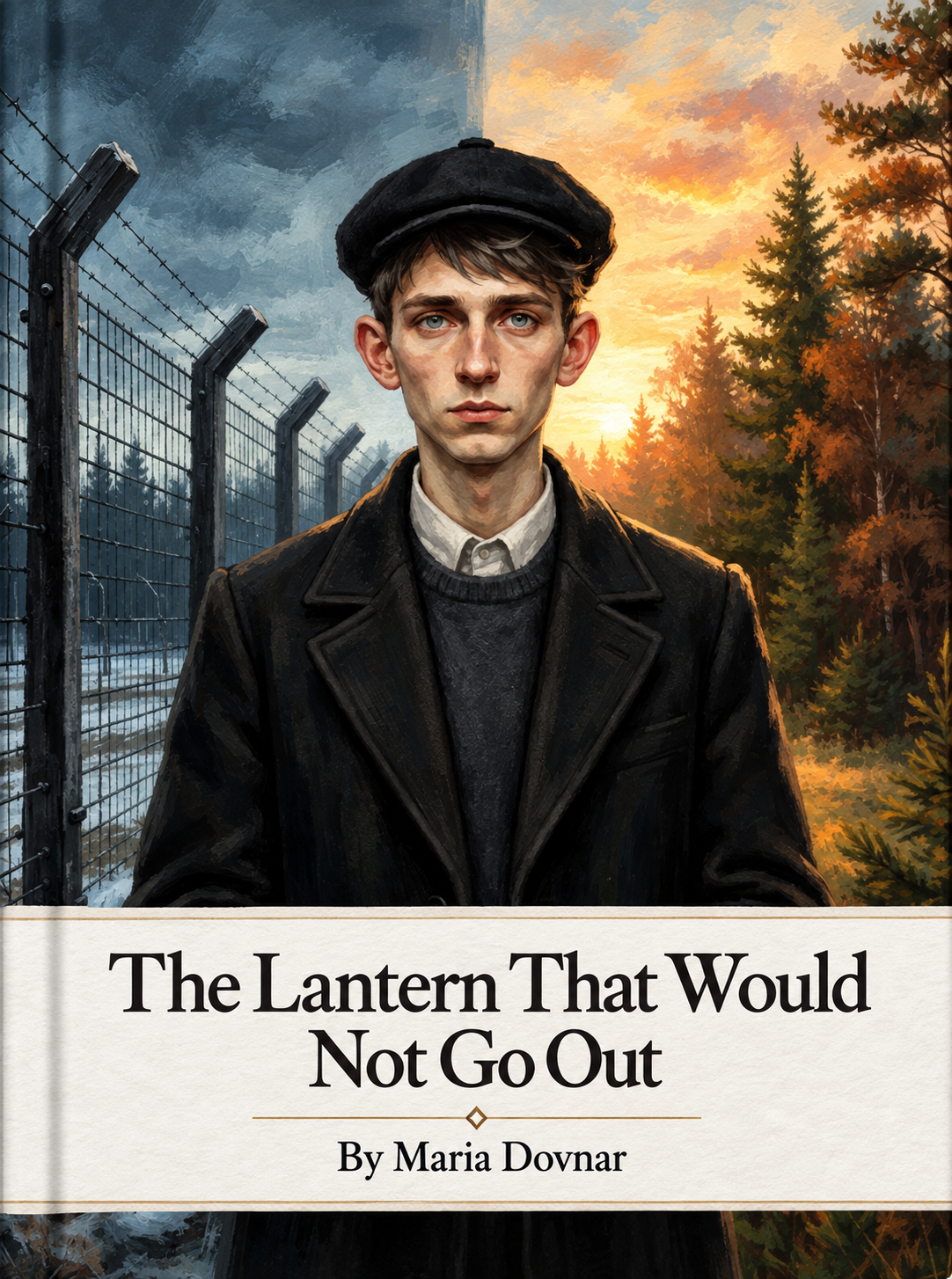
Chapter 1. The Boy Who Carried a Little Light
Once upon a time, in a land of green forests, quiet rivers, and villages with wooden houses, there lived a boy named Balys.
Balys loved listening to stories. His grandfather told him tales about brave people who had protected their homeland, while his mother taught him that a person's words could be as precious as gold.
“Words are strange things,” his grandfather once said. “You cannot hold them in your hands, yet they can help someone find their way through the darkest night.”
Balys kept those words in his heart.
But the land where he lived was passing through difficult times. First came one occupation, and then another. Soldiers appeared on the roads, people grew afraid to speak freely, and some families disappeared from their homes without warning.
One winter evening, Balys noticed that the lantern in his window had gone out.
He struck a match and lit it again.
“Why do you keep lighting that little lamp?” his grandfather asked.
“So people can see that someone is still here,” Balys answered.
His grandfather smiled sadly.
“Then remember, Balys. Sometimes a light is not meant to brighten a room. It is meant to remind the world that darkness has not won.”
From that evening on, Balys imagined that he carried a small lantern inside himself. It was invisible to everyone else, but he promised never to let it go out.
Chapter 2. The Kingdom of Silent Doors
As Balys grew older, the land fell under the rule of a powerful empire that wanted everyone to think, speak, and remember in the same way.
The empire's servants travelled from village to village, searching for forbidden books, letters, and stories. They believed that if they locked away enough words, people would eventually forget how to speak the truth.
One morning, Balys found a folded sheet of paper beneath his door.
It contained no treasure map, no royal decree, and no secret spell. It held only the names of people who had been taken away from their families.
Balys read every name carefully.
He understood that behind each name stood a person who had once laughed, loved, worked, dreamed, and hoped.
He began collecting stories about those who had vanished. Sometimes people whispered them to him in kitchens. Sometimes they slipped notes into his hands at train stations. Sometimes all they could offer was a name and the date on which someone had disappeared.
Balys kept the papers hidden.
“Why collect these sad stories?” asked a young neighbour named Lina.
“Because a locked door cannot change what happened on the other side,” he replied. “And silence cannot make a person never have existed.”
Lina helped him copy the names into a small notebook.
They gave the notebook no grand title. On its first page, they wrote just three words:
We Remember Them.
They knew the notebook might be discovered. They knew that telling the truth could be dangerous.
Yet every time Balys added another name, the invisible lantern inside him seemed to grow a little brighter.
Chapter 3. The Winter Without Windows
One night, the empire's guards came for Balys.
They searched his room, took his papers, and led him away before dawn. He was sentenced to many years of imprisonment and sent far from his homeland, to places where the winters were bitter and the fences seemed to stretch beyond the horizon.
In the prison camp, the days followed one another like grey stones. The prisoners worked in exhausting conditions. The wind slipped through their clothes, and the guards watched them closely.
There were no familiar forests, no village bells, and no warm window with a lantern shining behind it.
Balys sometimes wondered whether the world had forgotten him.
Then, one evening, an old prisoner sat beside him.
“Do you remember your home?” the man asked.
“Every day,” Balys answered.
“Then tell me about it.”
So Balys described the forests, the rivers, the smell of bread, and the sound of rain on wooden roofs. He told the man about people whose names he had recorded and about the little lantern in his childhood window.
The old prisoner listened with closed eyes.
“When you speak of home,” he whispered, “I can almost see it.”
After that, Balys began sharing memories with other prisoners. They told him their own stories, and he listened carefully. He learned that every person carried a world inside them, even when the walls around them were high.
The guards could take away books and letters. They could move prisoners from one camp to another.
But they could not easily confiscate a memory once it had been shared.
And so, in the winter without windows, Balys discovered that a story could become a lantern passed from one person to another.
Chapter 4. The Library Beneath the Snow
Years passed. Balys spent a great part of his life in prisons, labour camps, and exile. Even after one release, he was arrested again because the authorities still feared what he knew and what he stood for.
Yet he continued to care about truth, human dignity, and the fate of political prisoners.
In our fairy tale, we imagine that one night, during a terrible snowstorm, Balys discovered a mysterious library beneath the frozen ground.
Its entrance appeared between two snow-covered stones. Down a narrow staircase, he found a room filled with thousands of empty shelves.
A small keeper with silver hair stood beside a desk.
“Welcome,” the keeper said. “This is the Library of Forgotten Names.”
“Why are the shelves empty?” Balys asked.
“Because people believe that once a person is imprisoned, silenced, or sent far away, their story disappears. The shelves will remain empty unless someone remembers.”
Balys opened his coat and took out the invisible lantern he had carried since childhood.
Its light filled the room.
He began placing names on the shelves. With each name came a memory: a mother's song, a child's drawing, a teacher's lesson, a letter never delivered, a promise made before a long journey.
Soon the shelves were no longer empty.
“Will this library protect everyone?” Balys asked.
“No,” said the keeper honestly. “Remembering cannot undo every injustice. But it can stop injustice from pretending it never happened.”
Balys understood.
He had not been collecting names merely to look back at the past. He had been helping the living understand what must never be repeated.
When he climbed back into the snow, the mysterious library disappeared. But the lantern remained, warm and bright inside his heart.
Chapter 5. The Morning of Open Doors
At last, the world began to change.
The empire that had imprisoned so many people grew weaker. Across Balys's homeland, people began speaking more openly. Families searched for the truth about their missing relatives, and former prisoners told their stories.
After many years away, Balys returned to Lithuania.
He was no longer the young man who had first lit a lantern in his window. Time had changed his face, and hardship had left its marks. But the light he carried had survived.
In 1990, Lithuania declared the restoration of its independence. Balys became one of the people who signed the historic act that helped restore the country's freedom.
Imagine, for a moment, that the invisible lantern inside him suddenly shone so brightly that every window in the land caught its glow.
In this fairy tale, the doors of the Kingdom of Silent Doors opened one by one. People stepped outside carrying old photographs, letters, notebooks, and memories. Some cried. Some embraced one another. Others simply stood in the sunlight, learning what it felt like to speak without fear.
Lina, now an old woman, found Balys in a crowded square.
“Do you remember the little notebook?” she asked.
“I remember every name I could save,” he replied.
“And the lantern?”
Balys looked towards the open windows of the city.
“I think,” he said, “it was never mine alone.”
For the light had passed from one person to another: from prisoners to their families, from witnesses to children, from those who remembered to those who were only just beginning to learn.
And although no lantern can burn forever in one person's hands, a light shared by many can travel across generations.
That is why, in this fairy tale, the lantern never went out.
Not because darkness had disappeared, but because people had learned to remember, to speak, and to stand beside one another.
And the most important magic of all was this: no human being should ever have to surrender their dignity in order to survive.