Chapter 1. A Borderland Family
Klaudijus Duž-Dušauskis (Belarusian: Klaudzij Duž-Dušeŭski) was born in 1891 in Hlybokaye, then part of the Vilnius Governorate of the Russian Empire, in a region that now belongs to Belarus. It was a land shaped by centuries of contact among Belarusian, Lithuanian, and Polish communities.
Several layers were intertwined in his family history. On his mother’s side, he descended from Polish nobility associated with the former Polotsk district. His father, Stepan, came from a peasant background and worked in construction. His parents reportedly described themselves as “Belarusians of Polish culture.” The phrase reflects an identity shaped by language, education, family memory, and the legacy of the former Polish-Lithuanian Commonwealth.
For Klaudijus, these elements did not necessarily contradict one another. The region’s history could not be reduced to the borders that appeared later. The Grand Duchy of Lithuania ruled vast territories that later became part of Belarus, while Polish culture and noble traditions influenced many families across the region.
As a child, Klaudijus helped his father with building work: he learned to draw plans and calculate costs, and he observed how buildings and bridges were constructed. These skills set him on the path toward engineering and architecture.
While studying in Vilnius, he came into contact with Belarusian cultural figures and the growing national revival. He began to regard himself as part of the Belarusian movement and supported its aspiration to build its own state and culture.
This became the defining distinction of his public life: his family background tied him to the Lithuanian, Polish, and Belarusian borderland, his political work served the Belarusian national movement, and his later architectural career became closely connected with Lithuania.
Chapter 2. A Flag for a Nation Seeking Its Future
In 1917, the February Revolution opened new possibilities for national movements across the former Russian Empire. Belarusian activists began looking for symbols that could represent their people and their aspirations for self-government.
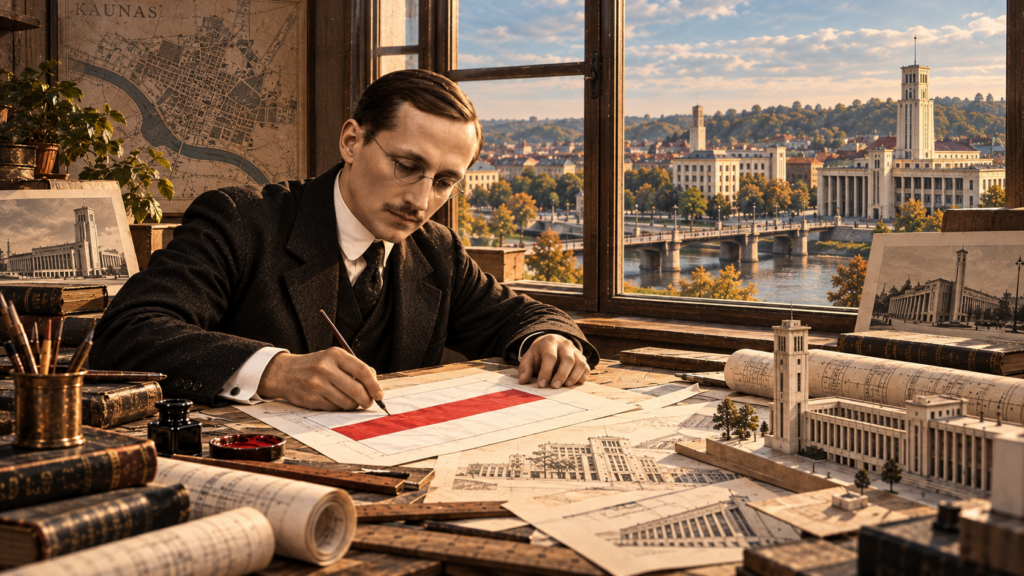
Duž-Dušauskis is widely credited with designing the white-red-white flag in 1917. In his own later autobiographical account, he recalled preparing several designs, one of which was accepted: white, red, white.
A popular legend tells of him working on the design on a February evening, among old books and the arguments of fellow activists. Supposedly, someone rushed out of a neighbouring room and exclaimed, “Where there are two Belarusians, there are three parties!” The remark is said to have inspired the idea of two white stripes separated by a red one. The scene has become part of the flag’s cultural memory, although contemporary sources do not firmly confirm it. The more reliable basis is Duž-Dušauskis’s own testimony that he prepared several designs and that the white-red-white version was adopted.
The flag became an important symbol of the Belarusian national movement and was associated with the Belarusian People’s Republic, proclaimed in March 1918. The simple combination of colours made it easy to recognise at gatherings and to carry for people who believed that Belarus could decide its own fate.
Chapter 3. The Pahonia, the Vytis, and the Politics of a Shared Heritage
The white-red-white flag was not the only historical symbol on which the builders of the Belarusian state relied. The Belarusian People’s Republic also adopted the Pahonia, a mounted knight originating in the heraldic tradition of the Grand Duchy of Lithuania.
In Lithuania, this symbol is called the Vytis and is the coat of arms of the present-day Lithuanian state. It shows that the legacy of the Grand Duchy is shared, yet each nation has preserved and interpreted it in its own way: Lithuanians, after restoring independence, regard the Vytis as a sign of the continuity of their statehood, while Belarusian activists chose the Pahonia as a historical argument for their state’s right to exist.
Some Belarusian activists also considered possible cooperation with Lithuania, hoping to protect themselves against pressure from Poland and Bolshevik Russia. Such plans were not merely a Belarusian dream: in 1918–1919, Lithuanian and Belarusian politicians did negotiate over a possible joint entity. However, opinions differed both in Lithuania and among Belarusians, and political interests were not identical.
The situation was further complicated by the fact that in 1920 Poland seized Vilnius and the Vilnius region, which Lithuania regarded as its capital. A shared medieval heritage did not mean that modern national movements had the same goals.
Duž-Dušauskis operated in this complex political environment as a Belarusian activist and diplomat. His story shows how a historical symbol can connect memory with modern political aspirations without erasing the separate identities of Belarus and Lithuania.
Chapter 4. A Belarusian Politician and a Lithuanian Architect
In 1919, Duž-Dušauskis became a diplomatic representative of the Belarusian People’s Republic in the Baltic region. He sought to defend Belarusian interests at a time when the borders and political future of Eastern Europe were still uncertain.
In 1921 he was arrested by the Polish authorities, and after his release he moved with his family to Kaunas, then the provisional capital of the Republic of Lithuania. This was a new stage in his professional life, but he gave up neither his Belarusian identity nor his political convictions.
In Kaunas he studied civil engineering at the University of Lithuania, graduating in 1927. He then worked in engineering and architecture and contributed to shaping Lithuania’s modern built environment. His projects included post-office buildings, industrial facilities, and other public infrastructure.
At this stage of his life he became a Lithuanian architect in the professional sense and made a significant contribution to the development of the country’s architecture. At the same time, he continued to support Belarusian cultural and educational activities in Lithuania.
This distinction matters. Duž-Dušauskis’s life was not a story of choosing one simple identity and renouncing all others. In it, Belarusian political activity, Polish noble ancestry, and a lasting contribution to Lithuania coexisted.
During the German occupation, he was imprisoned because he refused to cooperate with the occupying authorities and helped Jews. Lithuania later honoured his efforts to save people with a posthumous award.
Chapter 5. A Legacy Beyond Borders
Klaudijus Duž-Dušauskis died in 1959, having survived Nazi occupation and Soviet persecution. He did not live to see the white-red-white flag become the flag of independent Belarus in 1991.
Today his legacy belongs to several connected narratives, and each should be understood in its own context. In Belarus, he is remembered as a national figure and the widely recognised author of the white-red-white flag. In Lithuania, he is remembered as an architect who helped shape the face of modern Kaunas, and as a man who saved others during the occupation. His family history reflects the old cultural world of the Polish-Lithuanian Commonwealth, including the Polish nobility of the former Polotsk district.
These connections do not negate one another. They reveal the layered identities of a borderland, where family origins, political convictions, language, and professional life do not always fit into a single national category.
Duž-Dušauskis’s story invites us to remember the past without oversimplifying it. A person can inherit a complex family history, dedicate political work to one national movement, and make a lasting professional contribution in another country.
His flag became a symbol of Belarusian aspirations, and his buildings became part of Lithuania’s architectural heritage. His life is a reminder that the history of this region is shared, interconnected, and richer than any single label.