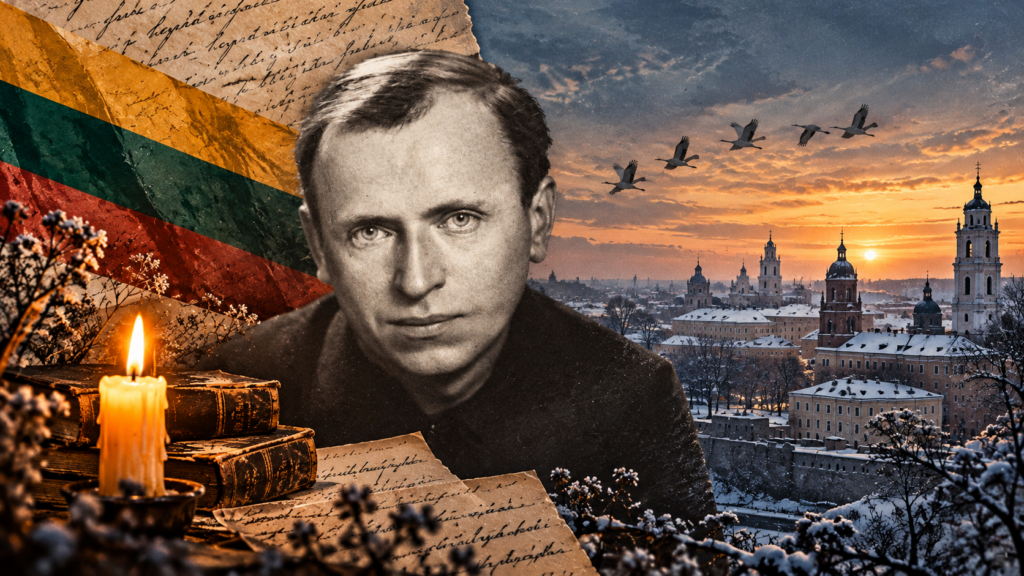
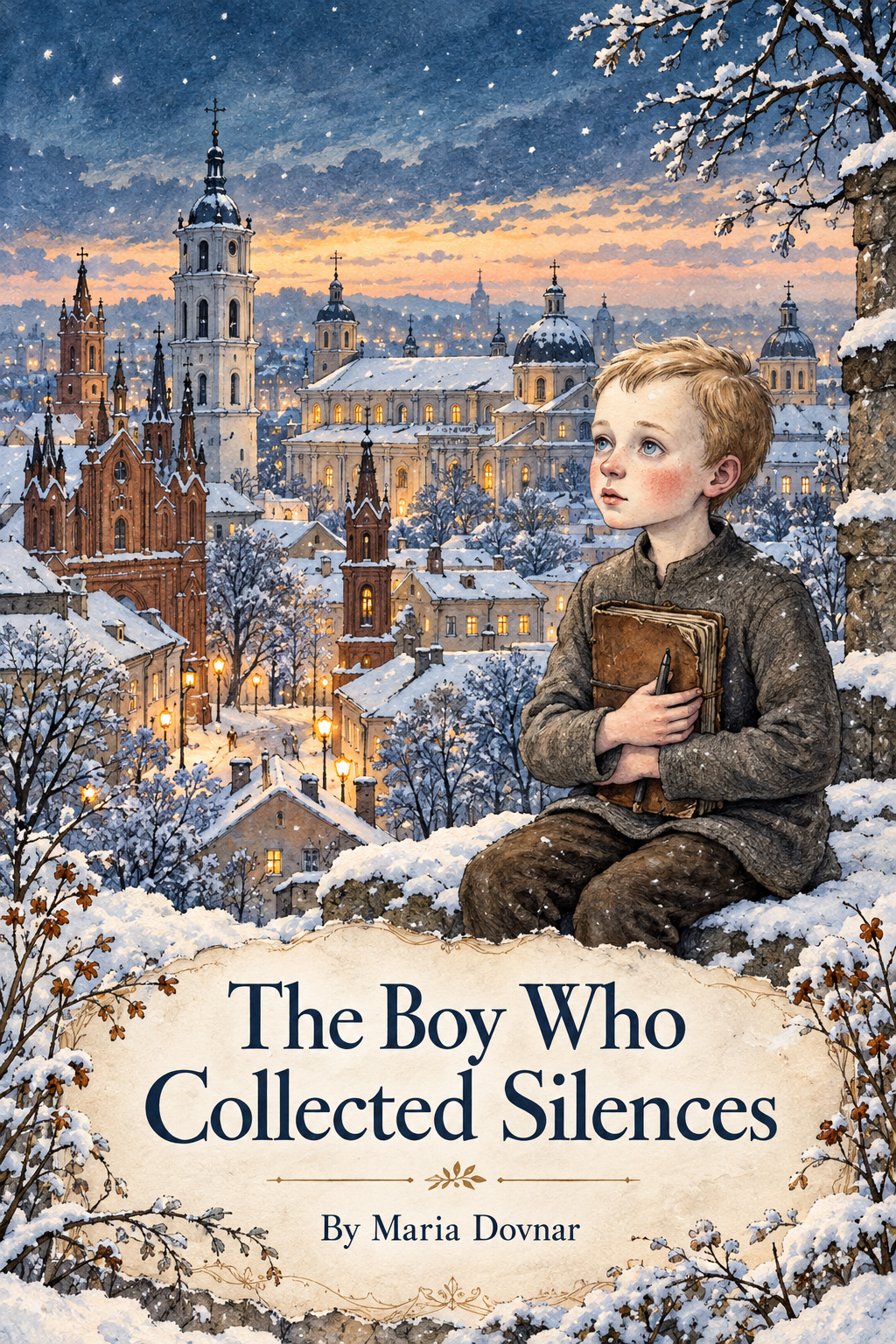
In a small Lithuanian village, where the birch trees wore silver coats in winter and the rivers remembered every stone they had ever touched, there lived a boy named Kazys.
Kazys had a peculiar gift. He could hear things that other people could not: the sorrow of an empty chair, the impatience of a seed beneath the snow, and the tiny sigh a book made when nobody opened it for a long time.
But what fascinated him most was silence.
“Why do people become quiet when they have something important to say?” he once asked his grandmother.
His grandmother was mending a woollen sock by the window. Outside, a crow was arguing with the wind.
“Sometimes,” she said, “people are afraid their words will hurt someone.”
“And sometimes?”
“Sometimes they are afraid their words will tell the truth.”
Kazys thought about this for three whole days, which was a very long time for a boy who usually had a question before breakfast.
At last, he decided to collect silences.
He kept them in the pages of an old notebook. There was the silence of a farmer who had lost his horse, the silence of a girl whose mother worked far away, and the silence of a man who had forgotten how to laugh. Kazys wrote a few words beside each one, not to explain it, but to make sure it would not be forgotten.
As he grew older, he discovered that a poem could do something extraordinary. It could enter a room where nobody dared to speak and quietly pull up a chair.
His poems travelled farther than he did. They went to villages where people worked until their hands ached, to kitchens where bread was divided into very thin slices, and to children who had begun to believe that the world was larger than their dreams only because grown-ups told them so.
One autumn, a stranger came to the village carrying a suitcase made of black leather. He wore a perfectly polished pair of shoes, though the road was muddy.
“I have come to make everything simpler,” he announced.
Nobody disliked simplicity. The villagers were fond of clear skies, honest arithmetic, and soup that did not require a dictionary to understand.
“What will you simplify?” asked Kazys.
“People,” said the stranger. “Their thoughts, their stories, their questions. A quiet person is a convenient person. A person who asks nothing is even more convenient.”
“And a person who writes poems?”
The stranger looked at Kazys's notebook as though it were a mouse that had wandered into his parlour.
“Poems make people remember things.”
“Is that bad?”
“It is inconvenient.”
The stranger offered Kazys a splendid new notebook with a golden clasp. It had a hundred blank pages, all smooth and white.
“You may write whatever you please,” he said, “provided that it pleases me.”
Kazys opened the notebook. On the first page, he wrote: *A bird is not free because its cage is beautiful.*
The stranger closed the book.
“That is not what I meant.”
“I know,” said Kazys.
There are moments in life when a person discovers that being good is not always the same as being obedient. It is a difficult discovery, and it rarely comes with applause.
The stranger left the village, but he did not leave Kazys alone. The poet was questioned, punished, and sent far from home. He learned that winter could be cruel even in places where snow never fell, and that a person could be surrounded by thousands of people and still feel terribly alone.
Yet he continued to write.
He wrote about people who shared their last piece of bread. He wrote about the dignity of work and the strange courage of those who refused to become cruel merely because the world had been cruel to them.
Years later, Kazys returned to Lithuania. He was older, and there were things he no longer spoke about. But he still carried his notebook.
In January, when the streets of Vilnius lay beneath the frozen sky, Kazys was taken away. He never returned home. His death came in circumstances that remain part of Lithuania's painful history.
For a long time, people spoke of him in whispers.
But a strange thing happened to the silences he had collected.
They did not disappear.
One lived in a poem copied by a student. Another survived in a story told by a mother to her daughter. A third travelled across the country inside a book whose cover had almost fallen off. And one, the smallest of all, waited between the pages of Kazys's old notebook.
Many years later, a little girl found it in a library.
She was not looking for a poet. She was looking for something to read because the rain had ruined her plans.
She opened the book and read a few lines.
Then she closed it and sat very still.
“What is it?” asked the librarian.
“I think,” said the girl, “that somebody I never met has understood something I couldn't explain.”
The librarian smiled. She had worked in the library for forty years and knew that this was one of the most important things a book could do.
Outside, the rain stopped. A blackbird landed on the windowsill and shook the water from its wings.
The girl went home and wrote her first poem. It was not a very good poem. One line was too long, another rhymed with a word it should never have rhymed with, and the ending was quite dreadful.
But she did not tear it up.
She put it in a drawer, where it waited patiently for her to become a better writer.
And somewhere, in the quiet country where birches turn silver in winter, Kazys's collected silences became a little less silent.
For a voice does not always survive in the sound it makes.
Sometimes it survives in the courage it gives to someone else.
And perhaps this is the secret the old poet had been trying to tell us all along: the world does not become poorer when a person dies. It becomes poorer when we forget to listen to what that person tried to say.