## I. The Mill at the Edge of the World
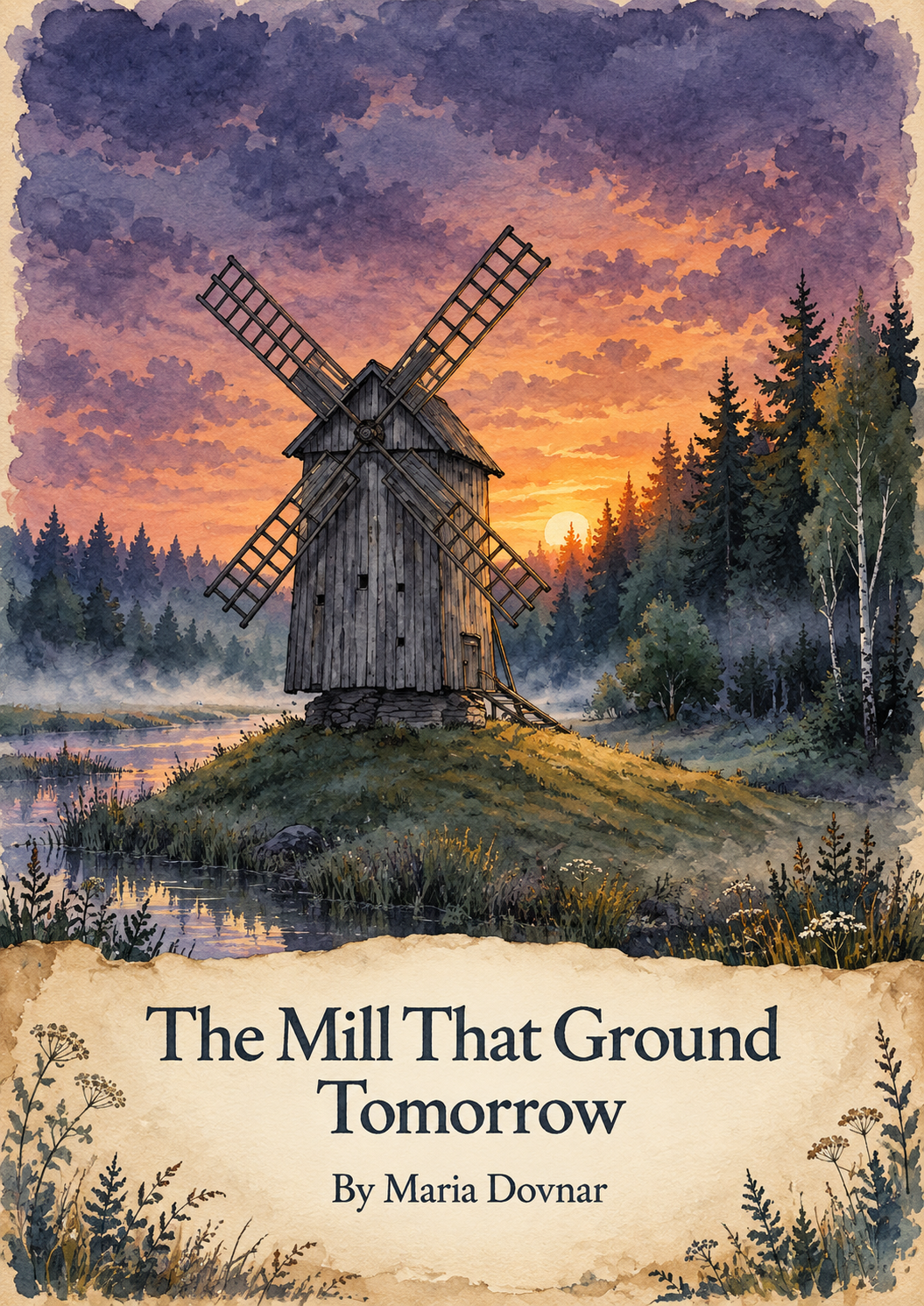
There was once a mill in Lithuania that stood where three things met: the forest, the marsh, and the sky.
Nobody knew who had built it. The oldest people in the village said it had been there before the first church bell, before the first road, and perhaps even before people had learned to give names to their sorrows.
Its sails turned when there was no wind. Its shadow pointed in the wrong direction at noon. And on certain evenings, when the sky was the colour of a plum, the millstones could be heard grinding long after the miller had gone to bed.
The villagers called it Tomorrow's Mill.
They said it could grind anything into something better.
A handful of rye became a sack of golden flour. A handful of sand became a handful of pearls. A handful of regrets became, for a little while, the feeling that one had done nothing wrong.
But nobody knew what happened to the things that went into the mill and never came out.
The miller was an old man named Baltaragis, whose beard was as white as flour and whose eyes were as blue as a winter morning. He lived alone with his daughter, Ona, who had a laugh so bright that even the crows sometimes stopped quarrelling to listen.
Baltaragis loved his daughter more than anything in the world.
And that, as you shall see, was the beginning of his trouble.
## II. The Visitor in the Green Coat
One evening, a stranger arrived at the mill.
He wore a green coat with silver buttons and carried no walking stick, although the road was long and the marsh was deep. His shoes were perfectly clean.
“Good evening,” he said. “I have come to make you an offer.”
“People who arrive after sunset with clean shoes rarely bring good news,” said Baltaragis.
The stranger smiled.
“I can give you anything you desire.”
“Can you give me a younger back?”
“No.”
“Can you give me a warmer winter?”
“No.”
“Can you make my daughter happy?”
The stranger looked towards the window, where Ona was singing as she kneaded bread.
“Ah,” he said. “That is a very expensive wish.”
Baltaragis frowned.
“I have money.”
“Money is what people give when they do not understand the price.”
The stranger sat down without being invited.
“I can give your daughter a life without sorrow. No illness, no loneliness, no tears. Every door will open before her, and every road will lead somewhere pleasant.”
“And what do you want in return?”
“Only a small thing. When the time comes, I shall ask for one day of her life. A single day. You will hardly notice its absence.”
Baltaragis looked at his daughter.
She was singing about a bird that had built its nest in a thorn bush, because the finest trees belonged to the king.
The miller thought of all the sadness that might one day find her. He thought of cold rooms, empty cupboards, and the terrible silence that follows a slammed door.
“One day,” he whispered. “Only one?”
“Only one,” said the stranger.
And because love sometimes mistakes fear for wisdom, Baltaragis agreed.
The stranger placed a silver coin on the table.
It had no face on it. On one side was a sunrise; on the other, a sunset.
“Keep this,” he said. “It will remind you that every bargain has two sides.”
Then he disappeared.
Outside, the mill began to turn.
## III. The Girl Who Could Hear Stones Cry
Ona grew up, and the stranger kept his promise.
Flowers bloomed wherever she walked. Her bread never burned. When she was sad, the rain stopped before it could wet her cheeks.
Yet something strange began to happen.
Every morning, Ona heard a quiet sound beneath the floorboards.
At first she thought it was a mouse. Then she thought it was water moving underground.
At last, she knelt beside the millstones and listened.
They were crying.
Not loudly. Stones do not know how to cry loudly. Their sorrow was a dry, patient sound, like sand slipping through an hourglass.
“What is wrong?” Ona whispered.
The millstones turned.
“We grind what we are given,” they answered. “That is our work. But lately we have been grinding things that should never have been taken from anyone.”
“What things?”
“Unsaid apologies. Forgotten promises. The courage people might have had tomorrow. The last words of those who were never allowed to finish their sentences.”
Ona drew back.
“Who gives you such things?”
“The man in the green coat.”
That evening she confronted her father.
Baltaragis sat at the table, turning the silver coin between his fingers.
“Father,” she said, “what did you promise the stranger?”
The old man grew pale.
“Nothing that could hurt you.”
“Then why are you afraid to tell me?”
He tried to answer, but his words fell apart before they reached his mouth.
Ona took his hand.
“I would rather have one honest winter with you than a hundred perfect summers bought with somebody else's sorrow.”
Baltaragis began to weep.
And the mill, hearing him, stopped for the first time in a hundred years.
## IV. The Market of Borrowed Tomorrows
Ona decided to find the stranger.
She followed the river upstream, through a forest where the trees leaned towards one another as though sharing secrets. At the edge of the marsh she found a market that appeared only after midnight.
There were stalls selling things no sensible merchant would ever offer.
One sold childhoods that had been too short. Another sold the dreams of people who had been told they were foolish. At a third, a thin woman in a red scarf sold second chances in little paper bags.
Behind every stall stood someone who had once wanted to escape pain.
And at the centre of the market sat the man in the green coat.
“You have come for your father's bargain,” he said.
“I have come to return it.”
“Impossible. Your father has already enjoyed its benefits.”
“Then take back the flowers,” said Ona. “Take back the summers. Take back every easy day.”
The stranger laughed softly.
“People are always willing to surrender what they have not yet lost. It is much harder when the thing has become precious.”
“Then take my happiness.”
“I already have it.”
Ona looked at him carefully.
For the first time, she noticed that his silver buttons were not silver at all. Each one was a tiny mirror, and in every mirror she saw a different face: a frightened child, a lonely woman, an old man sitting beside an empty chair.
The stranger was wearing other people's wishes.
“What are you?” she asked.
“I am the answer to a question people ask when they are afraid.”
“What question?”
“How can I have everything I love without ever being hurt?”
Ona was silent.
Then she said, “There is no such answer.”
The stranger's smile vanished.
## V. What the Mill Must Grind
They returned to the mill together.
The sky was turning grey. Somewhere in the distance, a church bell rang for morning.
The stranger held out his hand.
“One day,” he reminded her. “That is all I am owed.”
Ona looked at her father, who stood in the doorway with the silver coin clenched in his fist.
Then she looked at the mill.
“What happens,” she asked, “if the mill grinds the bargain itself?”
The stranger stepped back.
“No one has ever asked it to do that.”
“Perhaps no one has ever dared.”
Ona placed the silver coin between the millstones.
The stranger rushed forward, but Baltaragis stood in his way.
For once, the old man was not afraid.
The sails began to turn. The wooden beams groaned. The millstones moved slowly, then faster, until the whole building trembled.
The coin cracked.
From inside it came a sound like a thousand people drawing breath at once.
The mill ground the sunrise and the sunset together. It ground the promise and the price, the wish and the fear that had given birth to it.
When the stones finally stopped, the silver coin was gone.
So was the stranger's green coat.
He stood before them in an ordinary brown jacket, looking tired and very old.
“What have you done?” he whispered.
“We have returned tomorrow to those who belong to it,” said Ona.
The stranger looked at his hands. One by one, the tiny mirrors had disappeared from his buttons.
He seemed smaller without them.
For a moment, Ona almost felt sorry for him.
Then he turned towards the marsh and walked away. His shoes were muddy now, and for the first time in his life, he looked like someone who had travelled a long road.
## VI. The First Imperfect Morning
Nothing became perfect after that.
The winter remained cold. The bread sometimes burned. Ona cried when someone she loved went away, and Baltaragis grew older each year.
But the mill no longer ground people's tomorrows.
It ground rye and barley, oats and wheat. Its stones sang their old song, and the villagers brought their grain without fear.
One morning, a boy arrived carrying a sack of rye.
“My mother says your mill is not as magical as it used to be,” he said.
Baltaragis laughed.
“Your mother is a sensible woman.”
“Then why should I bring my grain here?”
The old miller considered the question.
“Because the flour is good,” he said. “And because we no longer charge people for being human.”
The boy thought about this.
“I don't understand.”
“You will,” said Baltaragis. “But I hope not too soon.”
Years later, when the boy had become a man, he told his own children the story of the mill that once tried to grind tomorrow.
He told them about the stranger who promised happiness without sorrow, and about the girl who understood that a life without sadness would also be a life without compassion.
And whenever his children asked whether the stranger had ever returned, he would look towards the old mill, where the sails turned in the evening wind.
“No,” he would say. “But his question still visits people.”
“What question?”
“How can we have everything we love without ever being hurt?”
Then he would stir the fire and add:
“If you ever discover the answer, children, do not be too quick to believe it.”
For the world is not a machine in which every sorrow can be exchanged for a pleasure, nor is the human heart a field that can be made fertile by removing every storm.
Some things grow because the rain falls.
Some people become kind because they have known grief.
And some stories survive because someone, somewhere, refuses to sell tomorrow.
The old mill still stands in Lithuania, where the forest meets the marsh and the sky.
Its sails turn when the wind is strong.
And sometimes, on a quiet evening, if you listen very carefully, you may hear the millstones singing.
They are not singing about magic.
They are singing about the precious, imperfect gift of being alive.