CHAPTER 1 — A BOY FROM NAVASIOLKI
Ales Dudar was born Aliaksandr Dajlidovich on 24 December 1904 in Navasiolki, a village in what is now Belarus. His family came from the landless peasantry. During the First World War, the family fled to Russia and returned to Belarus in the spring of 1917. After finishing school in 1921, he joined a theatre troupe led by Uladzislau Halubok. That same year, his first poem appeared in print.
CHAPTER 2 — THE VOICE OF A GENERATION
In 1923, Dudar became one of the founders of Maladnyak, a literary association of young Belarusian writers. He studied literature and linguistics at Belarusian State University in Minsk in 1927–1928. A campaign against Belarusian student writers forced him to leave the university. He later joined Polymia, another literary association. His books included Rebellious Belarus and Along Sunny Paths, both published in 1925.
CHAPTER 3 — THE POEM THAT CROSSED A LINE
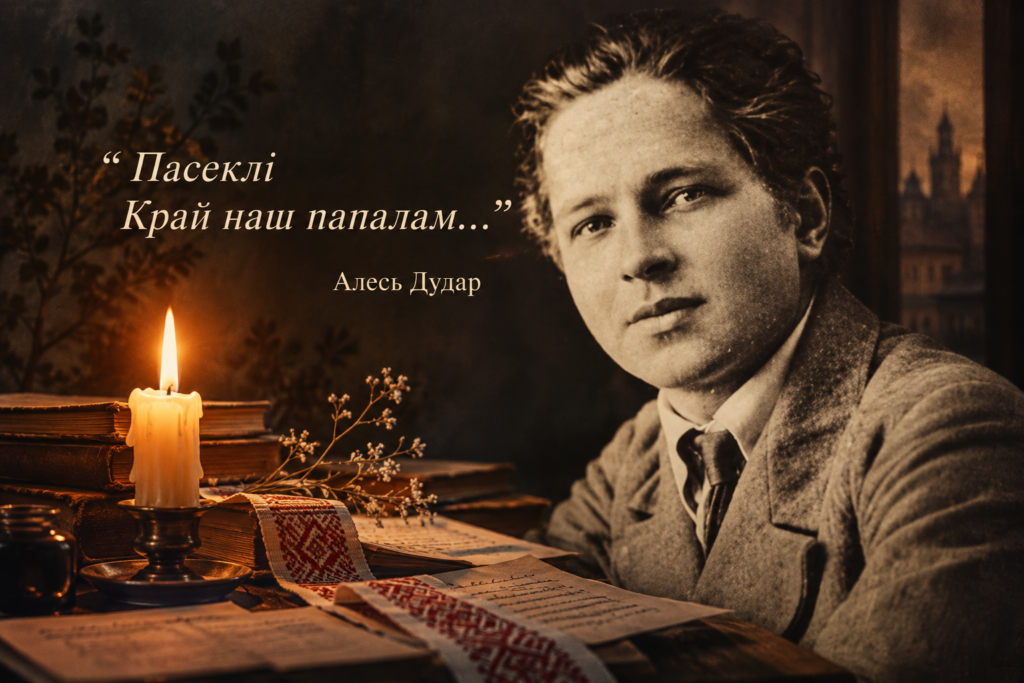
In 1928, Dudar wrote Pasekli Krai Nash Papalam — “They Cut Our Land in Two.” The poem condemned the division of Belarusian lands and attacked those who traded the country’s interests for political advantage. On 20 March 1929, the authorities arrested him because of the poem. He was sentenced to three years of exile in Smolensk, outside Belarus. In 1930, he was arrested again and brought to Minsk for questioning in the fabricated case of the Union for the Liberation of Belarus.
CHAPTER 4 — THE LAST NIGHT
Dudar eventually returned to Minsk and continued writing, translating and working as a literary critic. In 1934, he became a member of the Writers’ Union of the BSSR. On 31 October 1936, the NKVD arrested him for the third time. On 28 October 1937, an extrajudicial NKVD body sentenced him to death on fabricated charges of belonging to an anti-Soviet organisation. He was executed in Minsk on 29 October 1937, aged 32. In 1957, the Soviet authorities posthumously rehabilitated him.
CHAPTER 5 — THEY CUT OUR LAND IN TWO
Pasekli Krai Nash Papalam
By Ales Dudar, 1928
They cut our land in two
To win a master’s favour.
“This part is yours, that part is ours”—
No conscience in the souls of slaves.
We carry into the new order
An old song, borrowed and foreign.
While others bargain over our fate,
We surrender our own heroes.
We dare not even speak or think
Without permission from the Kremlin.
Our free spirit burns in silence:
Where are you now, where are you?
But the day will come, the poet wrote,
When the sun will shine in Belarusian.
And we will return to our country,
With shield in hand—or on the shield.