
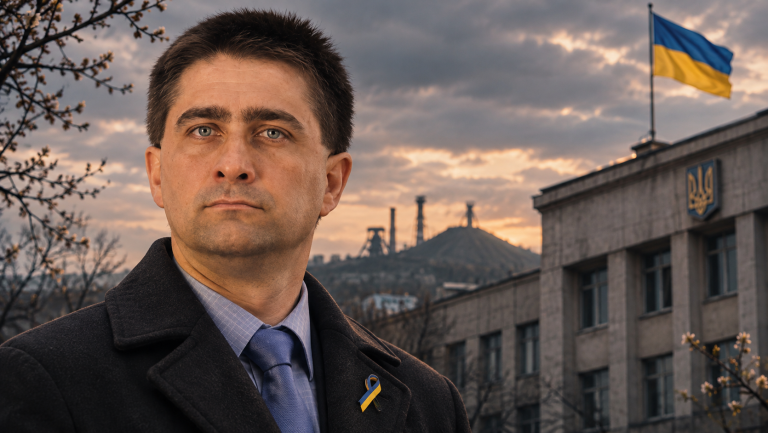
Chapter 1. A Life in Horlivka
Volodymyr Ivanovych Rybak was born on 30 November 1971 in Horlivka, Donetsk region, in eastern Ukraine. He grew up in a region whose industrial towns, mining communities, and working families formed an important part of the country’s social and cultural landscape.
Rybak studied at the Horlivka Motor Transport Technical School and later continued his education at the Automobile and Highway Institute of Donetsk National Technical University. He also studied law at the Interregional Academy of Personnel Management.
His professional and public life developed in his home region. He became involved in local politics and joined the All-Ukrainian Union “Fatherland” (Batkivshchyna) in 2009.
In 2010, he was elected to the Horlivka City Council. He served on the council’s housing and communal services commission and became known for his pro-Ukrainian political position.
For Rybak, local government was not merely an administrative institution. It was a place where decisions about the city and its people had to be made in the interests of the community.
Chapter 2. A City Divided
In the spring of 2014, Ukraine was experiencing a profound political and security crisis. Following the Revolution of Dignity and the flight of President Viktor Yanukovych, Russia occupied Crimea. Pro-Russian armed groups began seizing administrative buildings in parts of Donetsk and Luhansk regions.
Horlivka became one of the cities where the struggle over Ukraine’s political future was increasingly visible.
Rybak openly opposed the separatist movement and defended Ukraine’s territorial integrity. He continued to speak publicly against the seizure of municipal institutions and the replacement of Ukrainian state symbols.
His position placed him in direct conflict with armed groups that were establishing control over the city.
In April 2014, the situation became increasingly dangerous. Rybak’s wife later recalled that he had been aware of the risks but continued his public activity.
On 16 April, he gave interviews in which he criticised the local authorities’ conduct and called on fellow councillors to defend the city’s constitutional order.
The following day, he would make one of his final public appearances.
Chapter 3. The Flag
On 17 April 2014, Rybak took part in a pro-Ukrainian gathering outside the Horlivka City Council building. The demonstration was held under the slogan “For a United Ukraine.”
After the gathering, he attempted to enter the municipal building and challenge the presence of the separatist flag.
He tried to remove the flag of the self-proclaimed Donetsk People’s Republic and restore the Ukrainian national flag.
A confrontation followed. Video footage recorded Rybak being surrounded and confronted by supporters of the separatist movement.
Later that afternoon, at approximately 6 p.m., several masked men forcibly took him away in a vehicle. Witnesses reported the abduction, and a criminal investigation was opened.
It was the last time Rybak was seen alive.
His action had been simple but deeply symbolic: he had refused to accept that an armed group could replace the legitimate symbols and institutions of his country.
Chapter 4. The River
On 19 April 2014, the bodies of two men were discovered in the Kazennyi Torets River near the village of Raihorodok, in Donetsk region.
One of them was identified as Volodymyr Rybak. The other was 19-year-old student and pro-Maidan activist Yuriy Popravka.
The Ukrainian Ministry of Internal Affairs reported that both victims had suffered severe injuries caused by torture before being thrown into the water while still alive but unconscious.
Rybak’s murder shocked Ukraine. He had been a local elected representative, a husband, and a father who had been abducted after openly defending his country’s sovereignty.
International human rights organisations documented his abduction and killing. Human Rights Watch examined video footage showing armed men surrounding and forcibly taking him away.
Investigations by Ukrainian authorities identified individuals suspected of involvement in the abduction and murder. Intercepted communications and other investigative materials were also examined in connection with the case.
The crime became one of the early documented examples of the violence used against people who opposed the armed seizure of Ukrainian territory in Donbas.
Chapter 5. A Flag That Remained
Volodymyr Rybak was posthumously awarded the title Hero of Ukraine in 2014 for his civic courage and defence of the country’s sovereignty and territorial integrity.
His name became associated with the first months of Russia’s war against Ukraine and with the people who refused to accept the destruction of their country’s independence.
Rybak did not command an army. He was not a military officer. He was a local politician who believed that the Ukrainian flag belonged on the building of his city council.
His story is a reminder that the defence of a country does not begin only on a battlefield. It also begins in municipal buildings, public squares, local communities, and the everyday decisions of citizens who refuse to surrender their rights.
The flag he tried to raise became a symbol of something much larger than a political disagreement: the right of a community to determine its own future.
Volodymyr Rybak’s life was taken, but the meaning of his final public act remains part of Ukraine’s history.
Historical Note
Volodymyr Ivanovych Rybak (30 November 1971 – April 2014) was a Ukrainian politician and member of the Horlivka City Council from the Batkivshchyna party.
On 17 April 2014, after participating in a pro-Ukrainian gathering, he attempted to remove the separatist flag from the Horlivka City Council building and restore the Ukrainian national flag. Later that day, he was abducted by masked men.
His body was discovered on 19 April in the Kazennyi Torets River near Raihorodok, Donetsk region. Ukrainian authorities reported that he had been tortured and thrown into the water while still alive but unconscious.
He was posthumously awarded the title Hero of Ukraine in 2014.
The precise circumstances of his death are documented by Ukrainian investigative authorities and international human rights organisations. This account distinguishes those documented events from questions of individual criminal responsibility, which require judicial findings.