
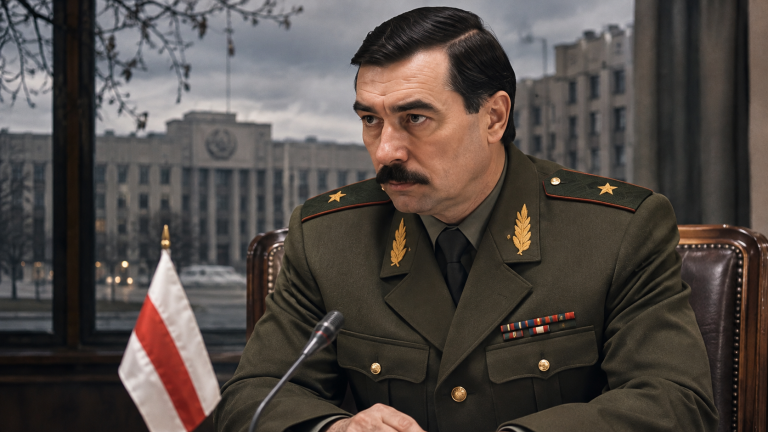
Chapter 1. From Vasilyevichy to the Ministry of Internal Affairs
Yury Nikolayevich Zakharenko was born on 4 January 1952 in Vasilyevichy, a town in the Rechytsa district of the Gomel region of the Byelorussian Soviet Socialist Republic.
He pursued a career in law enforcement and graduated from the Volgograd Higher School of the USSR Ministry of Internal Affairs in 1977. In 1987, he completed further studies at the USSR Ministry of Internal Affairs Academy.
Beginning his professional career as an investigator, Zakharenko worked in Svetlahorsk and Gomel. He later held senior positions in the internal affairs administration of the Gomel region and in the Ministry of Internal Affairs of the Soviet Union.
After Belarus became independent in 1991, he continued working in the country’s law enforcement institutions. He headed investigative structures within the Belarusian Ministry of Internal Affairs and became one of the senior figures in the newly independent state’s security and policing system.
His professional experience and military rank eventually brought him to the highest position in the country’s police administration.
Chapter 2. Minister in a New Belarus
In July 1994, following Alexander Lukashenko’s election as president, Zakharenko was appointed Minister of Internal Affairs of the Republic of Belarus.
He became a Major General of the internal service and led one of the most powerful state institutions in the country.
His appointment came during a period when Belarus was still defining its political institutions and the relationship between the presidency, parliament, and law enforcement agencies.
However, his time in office was relatively short.
In October 1995, Zakharenko was dismissed from the position of Minister of Internal Affairs. In April 1996, his special rank was reduced to that of militia colonel, and he was dismissed from the Ministry.
The circumstances surrounding his departure marked a turning point in his life. A man who had once headed the country’s internal security system was now outside the government and increasingly critical of the direction in which Belarus was moving.
Chapter 3. An Officer Joins the Opposition
After leaving the Ministry of Internal Affairs, Zakharenko did not withdraw from public life.
He became involved in efforts to unite former and serving military and law enforcement officers who opposed the politicisation of state institutions. He helped establish the Union of Officers of Belarus, an organisation that sought to defend professional standards and the constitutional role of the security services.
In 1996, he joined the political council of the United Civic Party.
By February 1998, he had become part of the opposition’s National Executive Committee, where he headed the security committee.
Zakharenko increasingly appeared at opposition events and worked with politicians who challenged the concentration of power in the presidency.
In the spring of 1999, he became involved in the political campaign of former Prime Minister Mikhail Chyhir, who was preparing to challenge Lukashenko in an alternative presidential election campaign. Zakharenko helped organise the campaign and travelled around the country.
His transformation was striking: a former interior minister and general had become an outspoken critic of the government he had once served.
He understood the institutions of power from the inside. His experience made his opposition particularly significant.
Chapter 4. The Night of 7 May 1999
On the evening of 7 May 1999, Zakharenko disappeared in Minsk while returning home.
According to information gathered during the investigation, he was forcibly taken by unidentified men and driven away in a car. His family reported his disappearance the following day.
The circumstances were alarming. Zakharenko had been politically active, had become a prominent opponent of the president, and had previously held one of the most senior positions in the country’s security system.
A criminal investigation was opened in September 1999 under the provision concerning intentional homicide.
His disappearance later became part of a wider pattern of cases involving prominent opponents of the Belarusian authorities. In September 1999, opposition politician Viktar Hanchar and businessman Anatol Krasouski also disappeared. Journalist Dzmitry Zavadski disappeared in 2000.
The Council of Europe investigated the disappearances and examined allegations that senior Belarusian officials had been involved in the abductions and possible executions.
In 2019, the Belarusian Investigative Committee reopened the investigation into Zakharenko’s disappearance following public testimony by former special police unit member Yury Garavski, who claimed to have participated in the abduction and killing of opposition figures.
These allegations have never resulted in a final judicial determination establishing the full circumstances of Zakharenko’s fate.
His body has never been found.
Chapter 5. The Man Who Has Not Been Found
More than two decades after his disappearance, Yury Zakharenko remains one of the most significant symbols of Belarus’s unresolved political disappearances.
He is remembered not only as a former Minister of Internal Affairs and Major General, but also as a person who chose to oppose authoritarian rule after having served within the state system.
His case became part of the struggle for truth and accountability in Belarus. His family has continued to seek answers, while human rights defenders and international organisations have called for a credible investigation into the fate of the disappeared opposition figures.
The disappearance of Zakharenko raises questions that go far beyond one individual: what happens when the institutions responsible for protecting citizens become instruments of political power? What protection exists for those who challenge the government? And how can a society preserve memory when the fate of its citizens remains unknown?
Yury Zakharenko’s story has no confirmed final chapter. His disappearance remains unresolved, and the demand to establish the truth continues.
Historical Note
Yury Nikolayevich Zakharenko (born 4 January 1952) was a Belarusian law enforcement official, Major General, and Minister of Internal Affairs of Belarus from 1994 to 1995. After leaving government service, he became an opposition politician and headed the security committee of the opposition National Executive Committee.
On 7 May 1999, he was forcibly abducted in Minsk and disappeared. A criminal investigation was opened on suspicion of intentional homicide. His body has never been found, and his fate has not been officially established.
Allegations of involvement by individuals connected to Belarusian security structures have been investigated and publicly reported. However, the precise circumstances of his disappearance and the responsibility of specific individuals remain matters requiring a credible judicial investigation.
This biography distinguishes documented events from allegations and unresolved questions.